Why you need to watch Spanish Snow White movie ...

  • Subscribe to our RSS feed.
  • Twitter
  • StumbleUpon
  • Reddit
  • Facebook
  • Digg
Showing posts with label 1940s. Show all posts

Sunday, January 18, 2015

Interview: Agent Carter costume designer Gigi Melton

Posted on 9:22 AM by christofer D
Previously: A guide to the 1940s costume design of Agent Carter

Agent Carter combines so many of my favorite things: comicbook adventures, a complex female protagonist, 1940s spy hijinks and, of course, beautiful costumes and set design. The post-war setting is a fascinating period to explore from a fashion history perspective, and I was happy to see that all of the costumes have a strong characterization element as well.

Costume designer Giovanna "Gigi" Melton caught my attention on Twitter with her many behind-the-scenes posts about her work on Agent Carter, and she was kind enough to grant me an interview. Read on for more background on the amazing costumes in this show, plus a selection of Melton's original design sketches.


HelloTailor: How did you go about researching and designing the overall look for the show? Were you influenced by any of the comics, or was it more a matter of exploring the 1940s aesthetic?

Gigi Melton: A combination of much research.  For Peggy the influences were Lauren Bacall, Katherine Hepburn, Hedy Lamarr. The smart, strong, fashionable and beautiful women of the era.


For SSR [Strategic Scientific Reserve] agents Dooley, Thompson, Sousa, and Krzmenski I researched government and detective looks. For eccentric Stark it was Howard Hughes and for Jarvis it was a British nod to tweeds. Coupled with comic book research, I took all of my inspiration and tailored it to create the individual looks for the scripted characters.


HelloTailor: I saw that you managed to source at least one vintage dress for Hayley Atwell, which made me wonder how many other costumes are original pieces from the '40s. A lot of historical dramas try to use a mix of vintage costumes and new designs, occasionally with vintage-style underwear to add authenticity to the look. Is this how you worked with Agent Carter?


Gigi Melton: Most of Peggy was built for the show, however there are  a few amazing vintage pieces in her closet.  We have vintage style lingerie but we modify with other pieces as well because of all the action. For Dooley, Thompson, Sousa and Krzmenski , their sport jackets and suits are about half vintage and half custom, all of their ties are vintage. With the exception of vintage ties, Stark and Jarvis are custom.


HelloTailor: How do you deal with creating clothes for action scenes? That must be tricky, especially since Peggy spends so much time wearing skirts.

Gigi Melton: Lots of multiples. As an example: the gold dress in episode one has a built foundation made with cotton trigger [a sturdy type of cloth], all boned so she do the kicking as well as being slammed around. Otherwise the fabric would have ripped. We make blouses and jackets with specific slits to allow for harnesses. For kicks in skirts I have vintage style black silk tap shorts to wear under.

Carter's disguise from episode 1 was inspired by Veronica Lake.

HelloTailor: Could you tell me a little about Peggy's red hat? Did you realize at the time that it was going to become such an important part of her image?

Gigi Melton: The red hat was scripted as:  A red hat in a sea of gray fedoras. For my design I thought,  Peggy is competing in this man's world, and her hat needs to be powerful to match all the fedoras but still be feminine. I truly had no idea it would take off this way.

Note the red, white and blue color scheme!
HelloTailor: I'd love to know more about how you differentiated between the male SSR agents, since they have to wear relatively similar outfits to work each day. Were you aiming to give Sousa a softer look with his cardigans?

Gigi Melton: For our SSR guys Dooley, Thompson, Krzeminski, and Sousa, each have a distinctive look befitting their character. Chief Roger Dooley (Shea Whigham) wears  strong double breasted suits; Jack Thompson (Chad Michael Murray) wears  single breasted with a fashion edge  coupled with suspenders; Daniel Sousa (Enver Gjokaj) wears sweater vests under his sport coats and pleated pants, I chose the sweater vests as a more approachable look, but also one that he could be comfortable with a crutch ; and Ray Krzeminski (Kyle Bornheimer) is a bit of a slob with his sport jacket, and open collar shirts. 

HelloTailor: Finally, Jarvis really stands out from the other male characters. Were you going for a particularly British style with his tailored suits, as opposed to a more American look sported by characters like Jack Thompson?


Gigi Melton: Yes -- I wanted his look to reflect his British roots, and the Jarvis look is very distinctive to all the other characters . The script  described him as a man in a tweed suit. But I wanted him to have a European style and aesthetic as well. So I felt the direction of a suit and vest, balanced with the casual but beautiful tweeds (which Britain is famous for) created a perfect look for his character as butler and front man for Stark. 


Previously: A guide to the 1940s costume design of Agent Carter
Further reading: ABC's featurette on Agent Carter's costumes, and Tyranny of Style's preview interview.
See also: The Bletchley Circle

Tumblr: HelloTailor
Twitter: @Hello_Tailor

Tweet
Read More
Posted in 1940s, agent carter, costume design, interviews, marvel, movie costumes i have loved, tv | No comments

Tuesday, January 6, 2015

A guide to 1940s costume design in Marvel's Agent Carter

Posted on 4:50 PM by christofer D
Marvel's Agent Carter begins tonight, and I wrote this Daily Dot article to coincide with the first episode. It's a spoiler-free background for Peggy Carter's costumes, and why the show is set during such an interesting period in fashion history.

Set in 1946, Agent Carter's seven-part espionage story is rooted in postwar culture. And like the first Captain America movie, one of its defining features is its 1940s aesthetic, immediately setting it apart from Marvel's other TV show, Agents of S.H.I.E.L.D.
The biggest influence on Western fashion in 1946 was, obviously, World War II. Fabric rationing led to a trend for simpler clothes, and women's fashions suddenly became more practical due to the influx of women joining the workforce—like Peggy Carter, whose career began in the Strategic Scientific Reserve during the war. These factors added up to women wearing low heels and plain, knee-length skirts without pleats or frills, and men wearing suits without cuffs or flaps on the pockets. 
Agent Carter takes place during a dynamic period in fashion history, the transition from wartime austerity to the postwar styles that would define the 1950s. By 1947 the French fashion industry was up and running again, and Christian Dior introduced the so-called "New Look" of nipped-in waists and flouncy calf-length skirts.
[READ MORE]
Read More
Posted in 1940s, agent carter, costume design, marvel, other writing, peggy carter, SHIELD | No comments

Wednesday, September 26, 2012

The Bletchley Circle, Part 2: Costume Design.

Posted on 3:39 PM by christofer D
Previously: The Bletchley Circle.

Historical dramas have a symbiotic relationship with costume design, with the clothes in high-profile shows like Downton Abbey receiving almost as much coverage as the stars. I suspect that this is one of the contributing factors to the popularity of historical movies about aristocrats, since it's a lot easier to interview Keira Knightley about corset logistics for the fiftieth time than it is to publicise a bunch of photoshoots of people wearing muddy pinafores and staid woollen caps. I love a good crinoline as much as the next girl, but sometimes movies about The Poors can be just as visually interesting because the costumes can illustrate more than just a statement of expense and luxury.
Downton Abbey is the reigning queen of costume-design coverage because it just entered the 1920s, and fashion magazines looooove the 1920s. Downton is in an enviable position, costume-wise, because several of its main characters are real clothes-horses and are rich enough that it's believable for them to be agonisingly on-trend as the show inches forwards into the first years of "modern" fashion. Once you reach the mid-20th century, popular fashions begin to move fast enough that most viewers will know the time period without much need for scene-setting, whereas it would take a historian to tell the difference between, say, 1830 and 1850 based on visuals alone. The problem is that it's easy to get carried away with year-by-year trend accuracy, and forget that not everyone could or even want to be up-to-date with the very latest styles.

Lucy
The popular image of 1950s fashion stems from Dior's New Look, a "return to femininity" after the supposed horror of having to wear trousers, uniforms and sensible shoes during wartime. (Unsurprisingly, the New Look was not immediately met with widespread jubilation -- I imagine that a couple of our Bletchley girls would have been less than enthused about the return of the corset girdle.) Full-skirted New Look outfits have never really gone out of style for things like prom dresses and semi-formalwear because they still represent a certain kind of 1950s ultra-femininity. But while The Bletchley Circle is set in 1952, it's very aware of the social background of its main characters, none of whom are exactly fashion plates. In some ways it reminded me of Tinker Tailor Soldier Spy, a movie whose story relied upon a particular historical setting but whose visuals were often strangely nebulous when it came to time-specific details. A couple of the younger characters in Tinker, Tailor were very obviously living in the 1970s, but many of the older men were either stuck in the past, or were just wearing the same suits they'd been wearing for the past twenty years. Which is, I think, satisfyingly realistic.
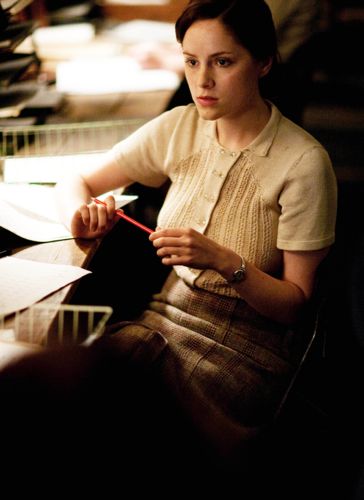
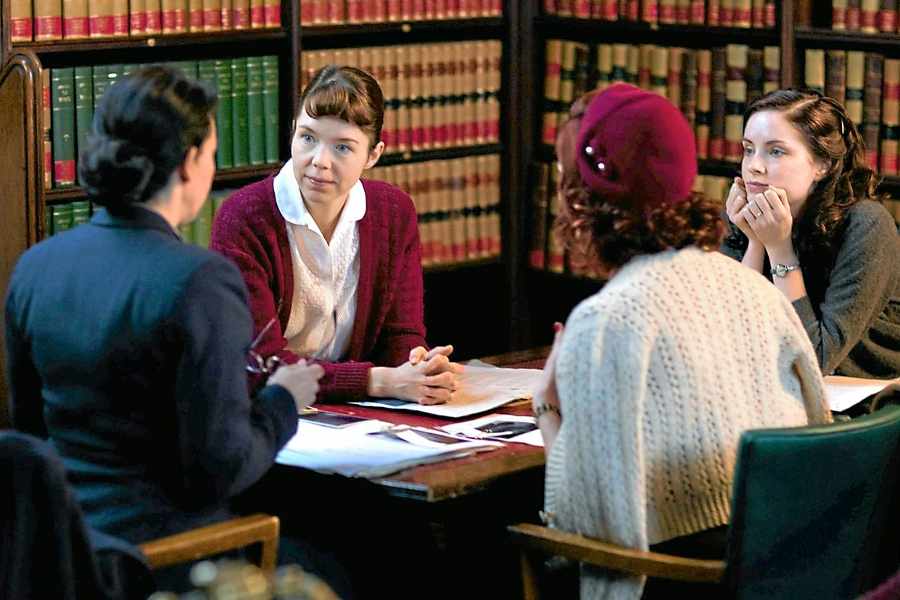
From left to right: Susan, Millie, Lucy, and Jean.
People don't just throw away all their old clothes as soon as a new decade rolls in. In The Bletchley Circle, Jean's matronly suits could easily have been worn by her character any time from 1935 to the present day, and Susan isn't much more fashion-forward. In fact, Susan is gloriously lacking in vanity, dressing in a selection of sensible, drab skirts and home-made knitwear. I kind of love the fact that she wears no makeup whatsoever, which is vanishingly rare to see on TV. It definitely adds to the contrast between Susan and Millie -- Millie being the character who spends the most time and money on her appearance despite probably being the poorest person in the group.
While Jean, Susan and Lucy are still mostly stuck with rationing-era clothes, Millie is closer in appearance to a classic 1950s look. She wears trousers and headscarves, and understands why a young woman would follow a strange man off a train in order to buy black-market cosmetics. When it comes to the moment when Lucy has to play decoy to lure in the Strangler, Millie is the one who supplies the dress and the lipstick. That scene was a real standout for me because the characters evidently had such a clear idea of what kind of look they were going for, whereas the end result seemed, to a modern eye, to be relatively sedate. It was a very narrow, precise cultural distinction, hinted at in the first episode when Susan's husband makes an offhand remark about the Strangler's victims being "not our kind of girls". That kind of girl being young single women who take the evening train home from work by themselves, and wear makeup. Yet if Lucy's temporary disguise as that type of girl had been introduced at the beginning of the show rather than halfway through (as a contrast to her frumpier outfits as a working-class housewife), I doubt that any viewer would have picked it out as being in any way unusual.
Lucy, after her makeover.
One last thing: UNDERWEAR. You do see Lucy getting undressed at one point, but I was pleased to find out that the costume designer made them all wear 1950s underwear under their clothes. This may sound like a weird thing to appreciate, but underwear does make a big difference to whatever is worn on top, particularly once you get beyond the long reign of the corset. Not only have ideal body-shapes changed a lot over the past few decades (thanks, idiotic internet memes, we know that Marilyn Monroe was "fatter" than "modern supermodels"), but "normal" body-shapes have changed as well. A middle-aged woman in 1952 would have been a young adult during the Great Depression and lived with rationing for over a decade of her life, which was definitely a contributing factor towards dress and waist sizes being dramatically smaller then than they are today. Add to that the fact that people were aiming for different body-shapes than we do, and it's surprisingly difficult for modern-day actresses to successfully wear fashions from 50+ years ago. Particularly if, as in this show, the costumes were at least partially made up of real vintage clothing. Some uncomfortable stockings and a pointy bullet-bra not only mean that the clothes look and fit better, but they help the actors stand and walk correctly as well.
Millie
Read More
Posted in 1940s, 1950s, costumes, it's historical, tv | No comments

Monday, May 14, 2012

The costumes and characters of The Avengers. Part 3: Steve Rogers, Captain America.

Posted on 12:11 PM by christofer D
Previously: The costumes and characters of The Avengers. Part 1: SHIELD. and Part 2: Tony Stark, Pepper Potts, and Bruce Banner.


As a person with maybe too many thoughts and feelings about superheroes (cf. all previous Avengers posts) I have no idea what an Avengers viewing experience is like for someone who doesn't know who Steve Rogers is. However, given the fact that Iron Man/Robert Downey Jr is such a big part of the current pop-culture zeitgeist, I assume that he's enough to hold the movie together for the few people in the audience who have no prior experience of Marvel superhero movies. Given the chance to advise one of the aforementioned newbies, though, I'd say that the prequels most likely to improve your Avengers experience are Captain America: The First Avenger, and Thor.

The Thor movie is relevent to The Avengers not as a source of backstory info for Thor, but more as Loki's own origin story. Already an unusually complex and emotionally engaging villain, Loki only becomes more interesting when you know more about his upbringing. As for Captain America, while I don't think that knowledge of Steve's backstory is necessary to understand The Avengers, an appreciation of his character definitely helps. Seeing Steve Rogers before his supersoldier transformation helps us understand the reason why he "is" Captain America rather than just a star-spangled man, and the fact that he's fresh from the '40s has the twofold influence of making him the ultimate fish-out-of-water character (perhaps even moreso than Thor, who has no real need to fit in with human society) and adding a horrendously depressing aspect to every one of his scenes because everyone he ever knew or loved is dead. The fact that Steve Rogers is even remotely functional in day-to-day life is tantamount to a miracle.
Steve's original 1940s uniform from Captain America.
Steve Rogers has the same goofily earnest attitude as Clark Kent/Superman, something that's rather hard to pull off in a movie aimed at the cynical bastards of 2012. It makes me worry that people who haven't seen the Captain America prequel might misunderstand the charm of the Steve Rogers we see in Avengers. I saw several reviews that commented that Cap seemed clunky or cheesy compared to the rest of the Avengers, and each time I got this ridiculous protective urge to be like, No! Watch his own movie! It's heartbreaking and inspiring and there's a musical number where he punches Hitler in front of a chorus line of girls in spangly stars-and-stripes minidresses! Man, I'm Scottish and a pacifist and barely have any patriotic spirit for my own country (unless you include gallows humour about rain and alcoholism), but if you don't like Captain America then I don't even know what to do with you. He's even better now than he was fifty years go because as a person he's really the exact opposite of the kind of jingoistic sentiment the 1940s propoganda "Captain America" was originally intended to be. Seriously, all I want for his sequel (aside from a scene where someone explains to Steve that Ronald Reagan became President of the United States) is for him to be a feminist, gay-friendly human rights advocate. Look, I can dream, OK!!
He just poses like that naturally. Because he's CAPTAIN AMERICA!!!
I feel like Avengers managed to make a little go a very long way with Steve Rogers, character-wise. While the lack of explicit backstory for characters like Hawkeye, Black Widow and Bruce Banner was most likely a timing issue, the lack of Cap-based exposition was necessary in order to avoid muddying the waters for the writers of the Captain America sequel. Steve Rogers' characterisation had to rely on in-the-moment reactions and visual details like costuming or Chris Evans' remarkable ability to have the facial expressions of a Disney prince. Joss Whedon did do some work on the script of Captain America: The First Avenger, and I have to wonder how much of that was stuff about his sense of humour/speech habits that carried over to The Avengers the next year.

There's very strong line of continuity between Steve's costumes in Captain America and The Avengers. When we first see him in the gym with Fury, the whole aesthetic is very retro -- the old-fashioned gym; the dusty sepia-tone colour scheme; the fact that Fury gives him an actual paper file. The detail of the paper file prop jumped out at me at once because it's so clearly something that Fury has tailored to Steve's comfort level -- or what he perceives Steve's comfort level to be. It made me think that Fury/SHIELD is making a conscious effort Steve feel more at home, and I'd hazard a guess that those attempts are doing more harm than good. At the end of The First Avenger when Steve wakes up in the 21st century, SHIELD has constructed a special 1940s bedroom for him in an attempt to slowly acclimatise him to the "future" -- which, of course, backfires. Although Fury mentions in the gym scene that Steve has his own apartment, I suspect that it's closely monitored by SHIELD, as is every aspect of Steve's life. And I suspect that Steve knows it. The mysteriously deserted 1940s-friendly gym is the first clue; the subtle weirdness of his casual clues are the next.

Steve's casual clothes are just really old-school. I don't believe for a second that he bought these himself because a) I doubt that SHIELD would allow him out into the chaotic environment of a 21st century shopping mall, and b) finding this type of outfit would actually be quite hard. His main casual clothes (see the first picture in this post) are high-waisted pleat-front suit trousers -- which aren't typically available in anything other than "70-year-old grandfather" dimensions, decidedly not the Adonis-like frame of Steve Rogers -- checked shirts, and an old-fashioned brown leather jacket with epaulettes. That jacket is way too specific in terms of quality, fit, and style for Steve to have been able to find it himself a few weeks after being defrosted. I'm very interested to see how his costumes evolve over the course of the next movie, because continuing to wear 1940s-esque clothing walks a fine line between comforting homesickness, and denial. Once he's truly autonomous from SHIELD and able to do everyday things like go shopping, will he stick with what's familiar or head straight for the future? I actually think it'd be a great characterisation decision if they had him leaping headfirst into 21st-century styles while retaining more retro tastes in things like music and movies.
Steve Rogers in the 21st Century. (The final scene of Captain America.)
The direct continuity crossover between the two movies is Steve's white t-shirt/khaki trousers outfit. When he emerges from the magical hot-body steroid machine in the Captain America movie the first things he puts on are the white t-shirt and khakis, which are then mirrored in the final scene when he escapes out into 21st century New York while dressed in a SHIELD t-shirt. At the beginning of Avengers we see the same outfit, this time with khaki workout pants -- which, don't tell me SHIELD didn't personally provide him with those because when was the last time you saw someone wearing khaki workout pants? And it's a great outfit for reasons other than continuity: it implicitly resembles military-issue clothing, the plain white t-shirt is the archetypal wholesome American staple item, and the colour scheme neatly slots into Steve Rogers' sepia/brown/beige palette.
This may seem like a stupid statement coming from someone who writes about both costume design and superheroes, but... I find it hard to write about superhero costumes. Comicbook costumes look cartoonish and ridiculous in real life, but the "realer" you make a live-action adaptation of a superhero comic, the less fun it is -- and the less likely you are to retain the core fanbase. Characters like Batman and Iron Man get a pass because their costumes are functional and double as body-armour, but Superman and Spider-Man? Sorry bro. I can watch it, I can enjoy the hell out of it, but I'm not going to waste time trying to legitimise how and why someone would make a perfectly-fitted spandex outfit for themself and then wear it in public. Especially in the context of urban crime-fighting as opposed to, say, lucha libre wrestling.

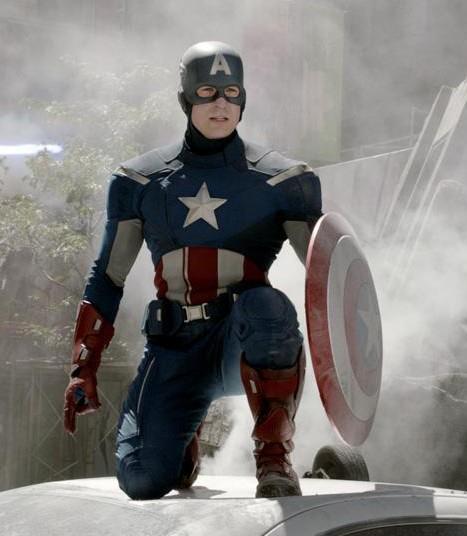
Captain America kind of falls into this category because his costume is, fundamentally, a 1940s Americana cheerleader uniform with extra pockets around the waist for bubblegum and hair gel (or whatever the hell it is that superheroes keep in their utility belts). That scene where Agent Coulson tells Steve that "the world needs a little old-fashioned" is enough for me, really. The body-armour and boots they've incorporated into the basic blue body-suit are feasibly practical-looking, and although the cowl isn't exactly great I'd like to see how you would go about designing a winged blue helmet that looks serious and manly. Cap is a cultural icon, a guy whose photo appears on trading cards, a symbol of a naiive, nostalgic idealism that never really existed even in the 1940s. He doesn't need to look cool. And the fact that he willingly puts on a stars-and-stripes catsuit and a helmet with a giant "A" on the forehead is proof enough of his beautifully earnest dedication to his job.
Source: mercmouth @ Tumblr. (Of course from Tumblr.)
I saw Avengers with two guy friends of mine, both of whom are well aware of my love of overanalysing movies and, more specifically, my sensitivity about the sexism present in most geek/superhero franchises. When we were coming out of the cinema, one of them asked if I'd been bothered by the way the film had displayed Black Widow and her catsuit. To which my reply was, basically, "???" because not only was The Avengers unusually equal-opportunities with regards to eye candy, but most of its prequel movies were as well. Both Thor and Captain America: The First Avenger featured sensibly-dressed, awesome female characters checking out the shirtless male heroes in what was pretty much a textbook reversal of the typical male-gaze "pan the camera up and down her body before she gets to say a line" shit you see in most blockbusters. I mean, I don't pretend to be an expert in cinematography, but Steve's first appearance in Avengers is a lingering shot of his ass flexing while he pummels the crap out of a punch-bag.
We know that Black Widow's pockets are full of weapons, but I still say that Cap's are full of bubblegum.
Black Widow may be wearing a catsuit, but so, more or less, are Captain America and Hawkeye, and no one of those costumes or characters is shot in a way that seems any more gratuitous than the others. Joss Whedon isn't perfect, but I feel that his policy regarding eyecandy visuals is indicative of his attitude towards his audience in general. ie, that his thought process is more like, "Who is my audience, and what would they like?" rather than the more typical Hollywood filmmaking attitude of, "This is the audience we think we're writing for, and this is what we've decided they enjoy". Which is how movies like Battleship and Catwoman get made.

Next up:  Black Widow, Hawkeye, Thor, and Loki! 

Links
If there's no such thing as a vintage Captain America venereal disease PSA then I'm going to be so disappointed.
The real contents of Batman's utility belt.
Read More
Posted in "it's historical", 1940s, avengers, captain america, marvel, movie costumes i have loved, movies, superheroes, uniforms | No comments

Monday, April 2, 2012

If there's no such thing as a vintage Captain America venereal disease PSA then I'm going to be so disappointed.

Posted on 2:23 PM by christofer D
One of my favourite parts of Captain America: The First Avenger is when Steve Rogers, clad in a delightfully low-budget proto-version of the "real" Captain America costume, goes on tour with a chorus of USO girls and stars in public service films urging all patriotic Americans to invest in War Bonds. Not only is Steve Rogers unendingly adorable in the role of bashful-yet-enthusiastic wartime mascot, but this one small montage leaves room for all sorts of great backstory elements: The urban legend of Captain America having punched Hitler in the face (he did, multiple times -- onstage), the idea of the comedically naiive Steve Rogers going on tour with a bunch of chorus girls in sexy outfits (it'd be like Some Like It Hot, except with superhero outfits!), the development of Steve's own ideas about the press and what it means to be a public icon... There are just so many possibilities! Actually, I think you should just watch the "Star Spangled Man" sequence, which caused me to grin so widely when I saw it in the cinema that I thought the top of my head was going to come off.
I only saw the movie once, but rewatching that clip I noticed something that for the 1940s, is pretty damn awesome: Cap's backing guys -- his unit, I guess -- is desegrated. I don't know enough about Captain America in general to comment on how that relates to comicbook canon, but I find it pretty unlikely that WWII propaganda films would be that liberal. Integrated units were still illegal in those days and I don't think I've ever seen a British or American military information poster featuring a non-white soldier. So I'm just going to go ahead and assume that Steve Rogers specifically asked for there to be some non-white guys marching alongside him in those PSA movies because he loves freedom and hates racism. (Seriously, I can't help but be fascinated with the idea of how Steve Rogers is going to react society -- and politics -- in 21st century America, and hope that the Avengers movie at least touches on this.)

From The Art of Captain America: The First Avenger.
I already predict that one of my favourite things about the Avengers movie is going to be the fact that they're really public superheroes. They have government backing via SHIELD (the somewhat-shadowy agency run by Nick Fury -- AKA Samuel L. Jackson in, well, all the individual Avenger movies), but more importantly they're pretty much destined to be celebrities. None of them even have secret identities! And as team leader, it's a good thing that Steve Rogers already has some PR experience because aside from Tony Stark, who is probably a tabloid disaster in multiple countries, none of the other Avengers have ever really been on camera. Bruce Banner would be a terrible interviewee because there's the constant danger of him hulking out under the pressure and trashing the Daily Show studio, and I suspect that Black Widow would shiv any journalist who tried to press her about her personal life.
All thoughts of Avengers aside, there's one single Captain America item that I am desperately hoping exists: A venereal disease PSA. Because seriously, STDs were a big problem during Wartime! And Captain America's job was to support and educate the troops! This whole concept is so beautiful to me because a) the addition of cheesy sexual innuendo to the now-retro wonders of WWII propaganda art can only be a good thing, b) in the movie, Steve Rogers is so unsure around women that he often just blushes and stammers at them, so god only knows how he'd cope with having to sing some cheery jingle with a title like "We Can't Defeat The Axis/Without Prophylaxis", and c) you just know that Tony Stark would track that ad down and post it on Youtube.
1940s VD posters. 
So I ask you, comicbook fans: has this ever happened in Avengers or Captain America canon, and if not, why not? If fanartists can produce beautiful poster art such as this, then I hope to goodness that someone somewhere has devoted such attention to a similar one in which Cap urges Our Boys to avoid the dangers of syphilis. Or that there's some fanfic out there, at the very least.

Postcript: Fun fact I learned while googling 1940s venereal disease posters: Stan Lee, one of the original creaters of The Avengers comics, was employed to draw one during WWII.
Read More
Posted in 1940s, avengers, captain america, movies, superheroes, uniforms | No comments
Older Posts Home
Subscribe to: Posts (Atom)

Popular Posts

  • Master & Commander: The Far Side of the World. (Part 2)
    Previously: Master & Commander, Part 1. The characters in Master & Commander have a lot to say about the division between Navy and n...
  • Costuming & design in NBC's Hannibal: Hannibal Lecter's wristwatch.
    As part of my ongoing series on costume and design in Hannibal , I'm going to post my first guest blog with contributions from an outsi...
  • The costumes of X-Men: First Class, Part 2: Menswear.
    Part 1: Womenswear. OK, let's be real here. 99% of this section is gonna be about Erik and Charles, firstly because 99% of the movie is...
  • Costuming and Design in Captain America: The Winter Soldier -- Steve & Bucky.
    Part 1: "Trust No One" -- How Captain America became the gritty superhero we never knew we wanted. Part 2: HYDRA, Sitwell, and div...
  • Teen Wolf 2x09: Party Guessed.
    Previously: Teen Wolf 101: An introduction to the eighth wonder of our world . (Now available in audio as well!) Why does Teen Wolf hate ha...
  • Capitol Couture in The Hunger Games.
    It's a little late for a review of the Hunger Games movie itself, so in summary: I thought it was an excellent adaptation, and the few t...
  • The ultimate TEEN WOLF DRINKING GAME.
    OK, the midseason finale is upon us. After tonight, there's no more Teen Wolf until January 2014. To help you deal with the pain, I'...
  • Harry Potter, costume design, and wizarding fashion in 1920s New York. (Part 2)
    Previously: Part 1 . Most wizarding robes in the Harry Potter movies are a combination of bell-sleeved faux medieval robes, and old-fashion...
  • Teen Wolf: Tattoo.
    Previously: Teen Wolf 101: An introduction to the eighth wonder of our world . Welcome to Teen Wolf! The show where the shirts are off, and ...
  • The costumes of Alien. Part 1: Uniforms and characterisation.
    It took me until the ripe old age of 22 to see Alien, mostly because my mother warned me for years that it was the Most Terrifying Film Ever...

Categories

  • "it's historical"
  • 1920s
  • 1940s
  • 1950s
  • 2014
  • accessories
  • agent carter
  • agents of shield
  • alexander mcqueen
  • alexander wang
  • alien
  • alien quadrilogy
  • aliens
  • apocalypse fashion
  • armour
  • avengers
  • bad movies
  • bad reviews
  • batman
  • bbc
  • benedict cumberbatch
  • big bang press
  • books
  • captain america
  • chanel
  • china
  • chris kane
  • comics
  • constantine
  • conventions
  • cosplay
  • costume design
  • costumes
  • couture
  • dance
  • dc
  • dior
  • dior homme
  • doctor who
  • dolce and gabbana
  • duckie brown
  • duro olowu
  • dystopias
  • elementary
  • erdem
  • fall 2012
  • fall 2013
  • fanart
  • fandom
  • fanfiction
  • fashion
  • fashion week
  • fausto puglisi
  • figure skating
  • game of thrones
  • gareth pugh
  • givenchy
  • goth
  • gwyneth paltrow
  • haider ackermann
  • hannibal
  • harry potter
  • hugo awards
  • hunger games
  • interstellar
  • interviews
  • IRL
  • iron man 3
  • it's historical
  • james bond
  • jason wu
  • jean paul gaultier
  • jonathan saunders
  • jw anderson
  • karl lagerfeld
  • ladies in suits
  • links post
  • london
  • london fashion week
  • louis vuitton
  • marc jacobs
  • marketing
  • marvel
  • mary katrantzou
  • masterpost
  • mcu
  • mediocre
  • menswear
  • menswear fashion week
  • milan
  • movie costumes i have loved
  • movie costumes i have loved
  • movie reviews
  • movies
  • mugler
  • needs more gold
  • neil marshall
  • new york
  • nyfw
  • oscars
  • other writing
  • ozwald boateng
  • pacific rim
  • paris fashion week
  • peggy carter
  • penny dreadful
  • persional taste
  • person of interest
  • personal taste
  • peter pilotto
  • podcasts
  • prabal gurung
  • pre-fall 2012
  • pre-fall 2013
  • pre-spring
  • prometheus
  • punk
  • ralph lauren
  • rants
  • resort 2013
  • retrofuturism
  • revenge
  • rick owens
  • s/s
  • scandinavia
  • sci fi
  • sci-fi
  • scotland
  • set design
  • shakespeare
  • sherlock
  • sherlock holmes
  • SHIELD
  • shoes
  • snowpiercer
  • spring 2012
  • spring 2013
  • spring 2014
  • star trek
  • star trek into darkness
  • star wars
  • starfleet
  • stargate
  • stoker
  • street style
  • suits
  • superheroes
  • superman
  • supernatural
  • tailoring
  • teen wolf
  • the hour
  • the row
  • theatre
  • theyskens theory
  • thom browne
  • thor
  • thor 2
  • threeasfour
  • tom ford
  • tom hiddleston
  • tv
  • ulyana sergeenko
  • uniforms
  • upholstery
  • versace
  • victoria beckham
  • video post
  • viktor and rolf
  • vivienne westwood
  • walter van beirendonck
  • watches
  • writing
  • x-men
  • yohji yamamoto
  • zac posen

Blog Archive

  • ▼  2015 (4)
    • ▼  January (4)
      • Hugo Award eligibility & 2014 masterlist
      • Interview: Agent Carter costume designer Gigi Melton
      • Behind the seams of the Oscars' costume design cat...
      • A guide to 1940s costume design in Marvel's Agent ...
  • ►  2014 (38)
    • ►  December (3)
    • ►  November (3)
    • ►  October (3)
    • ►  September (1)
    • ►  August (1)
    • ►  July (3)
    • ►  May (1)
    • ►  April (8)
    • ►  March (4)
    • ►  February (2)
    • ►  January (9)
  • ►  2013 (68)
    • ►  December (2)
    • ►  November (2)
    • ►  October (7)
    • ►  September (9)
    • ►  August (5)
    • ►  July (9)
    • ►  June (6)
    • ►  May (4)
    • ►  April (3)
    • ►  March (5)
    • ►  February (11)
    • ►  January (5)
  • ►  2012 (122)
    • ►  December (6)
    • ►  November (11)
    • ►  October (11)
    • ►  September (13)
    • ►  August (9)
    • ►  July (12)
    • ►  June (13)
    • ►  May (8)
    • ►  April (6)
    • ►  March (7)
    • ►  February (13)
    • ►  January (13)
  • ►  2011 (32)
    • ►  December (8)
    • ►  November (10)
    • ►  October (13)
    • ►  September (1)
Powered by Blogger.

About Me

christofer D
View my complete profile