Why you need to watch Spanish Snow White movie ...

  • Subscribe to our RSS feed.
  • Twitter
  • StumbleUpon
  • Reddit
  • Facebook
  • Digg
Showing posts with label sherlock holmes. Show all posts

Monday, January 20, 2014

Postscript to "His Last Vow": How things might have turned out.

Posted on 10:59 AM by christofer D
Previously: Sherlock, "His Last Vow."

In my review of "His Last Vow," I talked about the way Sherlock never seems to suffer any consequences for his actions, and how the quality of the show suffers as a result. It's kind of a balancing act, because ultimately even I don't want Sherlock to face completely realistic consequences. Much of his appeal as a character is down to the fact that he says and does things that no normal person would ever dare to do, so the show wouldn't be the same if he was realistically bound by the legal system, or even by social niceties. But when your protagonist finds himself facing even less pushback than Hugh Laurie in House, MD (who regularly bullied his patients and forced his underlings to commit burglary), then you have a problem.
A couple of readers mentioned to me last week that technically, Sherlock was "punished" for Magnussen's murder, in that his assignment in Eastern Europe was implied to be a death sentence. But the fact is that this potential storyline is erased within minutes. Sherlock may accept Mycroft's legally ambiguous banishment, but it's immediately cut short. The narrative saves him from having to go through any kind of real personal difficulty, which effectively removes most of the power of Magnussen's inevitable demise. It could have been a classic story: Sherlock commits to killing Magnussen because he knows it's the only way to defeat him, but he also knows that by killing Magnussen, he has to make a sacrifice. Specifically, the sacrifice of his freedom and reputation, which he only just got back. The result of removing that sacrifice from the equation is that the act of killing Magnussen comes across as just another example of Sherlock's arrogance.
I've been thinking about the kind of storylines Sherlock could have included this season, if they'd decided to follow events through to their natural end. Obviously these aren't serious suggestions, because Sherlock is never going to disrupt its internal universe to this extent. Like most crime shows, the central characters can perform seemingly world-changing (or at least life-changing) feats, but reality somehow just seems to reset itself afterwards. The inner circle of Sherlock's personal relationships may develop and change as the series progresses, but the world around him basically stays the same, even when he takes on a case that could have a major influence on British politics.

The only major change we see is the gradual evolution of Sherlock's celebrity status, but we still don't see it affect him much in daily life. In fact, by the end of season 3 the celebrity situation has actually become pretty implausible, because he's portrayed as being headline-grabbing tabloid fodder... who is still perfectly able to go about his day-to-day business without any kind of trouble from paparazzi or crime reporters. His supposed fame only surfaces when the writers want to reference fandom, either through Sherlock fangirls or conspiracy theorists like Anderson. His return from the dead is instantly broadcast on BBC news as a breaking story, and yet no one recognises him when he's undercover at a drug den, or breaking into Magnussen's office (which is presumably full of journalists!) or wandering around central London in his trademark coat.

I understand the reasoning behind this. Having the world remain static around your characters means you can still comfortably write the same kind of storylines for multiple seasons, and there's nothing intrinsically wrong with that. While I do think that it's lazy writing for Sherlock to avoid any kind of consequences after shooting someone in the head, it's understandable to want the general scenario of the show to remain within the viewers' comfort zone: ie, John and Sherlock solve crimes in London. However, just think of the possibilities if you really did allow Sherlock's actions to have realistic consequences!

The Empty Hearse
When watching this episode, I began to wonder what it would be like if Lord Moran's plan actually succeeded. Sure, John and Sherlock would have to survive somehow (maybe they were inconveniently arrested for jumping the turnstiles in the Underground?) but the Houses of Parliament would be blown up. Most of the British government would be wiped out in one fell swoop, and the country would suddenly be run by a handful of backbench MPs, local councillors, the House of Lords -- and Mycroft Holmes. Perhaps martial law would be declared. London would certainly be on lockdown. The entire world would change overnight, and all future Sherlock mysteries would take place in a dystopian future AU in which London was ruled by a police state of anti-terrorism paranoia and surveillance. (Well, even more than it is in real life, anyway.)

The Sign of Three
I already mentioned this in my episode review, but I found it HIGHLY unrealistic that no one was filming Sherlock's public meltdown at John and Mary's wedding. In reality, someone would probably have filmed it and put it on YouTube, thus bringing Sherlock to viral fame status and destroying his ability to go undercover without a seriously in-depth disguise. In keeping with the episode's comedic theme, this would be the point at which Sherlock becomes a public laughingstock as opposed to a mysterious cult figure.

His Last Vow
This is the big one. Sherlock shot a man in the head in front of multiple witnesses, so either he needs to face legal consequences or there needs to be a seriously good explanation for how Mycroft prevents this from happening.
  • Cover-up. This is presumably what will happen in canon, since Sherlock's only punishment was Mycroft unofficially shipping him off to Eastern Europe. I assume that Mycroft's footsoldiers are all bound by confidentiality laws and couldn't tell anyone about what they saw, but Magnussen's private guards and household staff are another matter entirely. How did Mycroft explain Magnussen's death, anyway? He's a very public figure, after all. And while many powerful people would almost certainly benefit from Magnussen's death, it would still be a major news story, even if they went the route of faking a plane crash or natural death.
  • Actual jail time. Sherlock killed a guy. He goes to court, explains the situation, and is sent to jail. He gets a lenient sentence because the judge was one of Magnussen's blackmail victims, but he's still gonna be incarcerated for a couple of years. In the meantime, John and Mary have cool adventures with Lestrade, and visit Sherlock regularly in jail so he can get to know the new baby. He assists in their investigations from behind bars, Hannibal-style, and reconstructs crime scenes inside his Mind Palace. They can even include a chase sequence where he "runs" alongside John, predicting where he's going to go while tracking down a criminal! Totally awesome. The season ends with him being release from jail, ready to start afresh in season 5. 
  • Dead man's switch. Sure, Magnussen could store all his blackmail information in his head, but for practical purposes it's stupid to think that he only relied on his Mind Palace. Particularly when keeping hard copies of his blackmail files is perfect insurance against, say, people trying to shoot him in the head. THIS IS BASIC BLACKMAIL SHIT, GUYS. Someone as clever and well-prepared as Magnussen should have kept a bunch of files on hand to be released via automated email, in the event that he was killed or kidnapped. Ideal opening scene for season four: Britain is in disarray after a vast amount of secret government files and shocking personal information about public figures was all simultaneously leaked online following Magnussen's death, like a tabloid scandal version of Wikileaks. Everything is utter chaos, and it's all Sherlock's fault for shooting first and asking questions later. Real, realistic consequences.
When reading an interview with Moffat & Gatiss the other day, I was surprised to discover that the dead man's switch issue does actually have an explanation -- just not within the actual episode. Basically, Magnussen was intended to be a classic supervillain who is brought low by his own hubris. Supposedly, Sherlock was able to kill him because he just didn't even consider the possibility of an assassination attempt. Now, I find this pretty difficult to swallow, considering how many enemies Magnussen must have had. But I might have been inclined to charitably accept it if there had been any significant hint of this character trait in the episode itself. In the Moffat/Gatiss interview, they discussed cutting a scene where Magnussen is swimming in his private pool and ignores John and Sherlock as being beneath his notice -- a scene that was meant to illustrate his aloof nature and lack of concern for other people.
I feel like you can kind of interpret this trait from the scenes where he pees in Sherlock's fireplace or flicks John's face, but those honestly feel more like he's bucking societal convention and acting like an asshole -- much like both Sherlock and Moriarty. This removal of a key character development scene is yet another thing I've noticed Moffat doing before with other characters. Most recently, he talked about deleting a few lines from the most recent Doctor Who Christmas special -- lines that would have explained Clara's tangled backstory and memory issues. But Moffat decided to remove this explanation on the grounds that viewers wouldn't really be "bothered" about it, which inevitably led to her character arc being even more confusing than before. I mean, I understand that not everything can make it into the final cut of an episode, but if you're going to engineer a seemingly undefeatable villain with one fatal, hidden flaw, then you do actually need to hint about what that flaw is. Otherwise, the explanation that he ~just didn't consider the possibility of someone trying to kill him~ kind of sounds like nonsense.

To me, the most serious potential consequence of "His Last Vow" is the dead man's switch. Things like Sherlock becoming a YouTube sensation are only going to happen as a momentary punchline, and he's most likely not going to spend any time in jail for his various crimes. But the fact remains that we never received an adequate in-universe explanation for Magnussen's lack of blackmail insurance against people trying to kill him. It requires us to believe that he had such a gigantic ego that he not only believed that he was undefeatable, but also that he was immortal. Which, in turn, requires us to believe that no one had ever attempted to kill him before. Except... didn't he have his own personal bodyguards, implying that he was very aware that he was in danger of physical attack at all times?

It's a problem. It's a serious problem. So until season four comes out, I'm electing to believe that as soon as Magnussen's death went public, all of his carefully-collected blackmail files began to leak to various news outlets, causing untold chaos among Britain's ruling classes. Sorry, Sherlock. Maybe you didn't win this one after all.

Previous Sherlock posts
Read More
Posted in sherlock, sherlock holmes, tv | No comments

Monday, January 13, 2014

"His Last Vow," Part 3: No consequences, no impact, no regrets.

Posted on 12:58 PM by christofer D
Previously: Part 2

My eventual reaction to the final scene of this episode was pretty simple:
I feel like the real title of BBC Sherlock should be "Sherlock Holmes: Special Treatment." Or perhaps, "Sherlock Holmes: No Consequences."
— Hello, Tailor (@Hello_Tailor) January 13, 2014
I love Moriarty, and I'll be psyched to see more of him next season. But his presence is indicative of one of Moffat's worst flaws as a writer: his complete inability to allow serious actions to have serious consequences. Sherlock coming back from the dead is a given, but Moriarty recovering from a gunshot to the mouth? Although, I suppose, he may not actually be "alive" next season. Perhaps he's committing crimes from beyond the grave. Luckily for the purposes of this review, there's another extremely obvious example of the total lack of consequences in this show: Sherlock's near-instant return from "exile" at the end of the episode.
My immediate assumption after Sherlock shot Magnussen was that next season, we'd be in for some kind of Hannibal-style crimesolving scenario where Sherlock is incarcerated but is occasionally sprung from jail to help solve the puzzle of the week. This would be an interesting development both for Sherlock as a character and for the show, because the reason why everything seems like such a hot mess right now is because there are no restrictions on anything. Sherlock has too much freedom, the writers have too much power, and everyone would benefit from cooling their heels in narrative prison for a while.

Of course, then it turned out that instead of going through the normal legal processes, Sherlock would be sent away to die in "Eastern Europe," that well-known bastion of dastardly criminal peril. At this point, one would expect him to fade tastefully off into the sunset, giving us a cooling-off period before he inevitably returns for the next season. Except a) that would be too similar to the gap between seasons two and three, and b) there are no consequences in Sherlock Land. So he's brought back after a mere four minutes, once again learning that he can do whatever he likes, as long as it's for a Good Cause. He doesn't need to feel guilty about Janine, he doesn't need to feel guilty about Magnussen, and he doesn't even need to feel guilty about that whole thing where he faked his own death and lied to his best friend about it for two solid years.

So. Sherlock is right and good and cool and awesome, and lives to play another day. Meanwhile, twenty to thirty people from the British government, Magnussen's personal staff, and Mycroft's team of soldiers, all get to live with the knowledge that Sherlock Holmes shot a man in the head in front of multiple witnesses, but will get away with it because he's famous and has a powerful brother. And that, really, is the true underlying message of this show.
This episode, and a great deal of the basic concept of Sherlock as a show, reads a lot like a story written by a young boy who has only ever been exposed to fantasy-fulfillment male antihero fiction. Sherlock is a stylish, witty, misunderstood genius who doesn't care (doesn't HAVE to care) what anyone thinks, and can be as rude as he likes and get away with it. He doesn't need or want women, but women become obsessed with him anyway, proving his desirability and superiority. He has a loyal best friend who stays with him even when he's acting like a total asshole. The world shapes itself around him. And sure, we know that Sherlock isn't a total Mary Sue because he has a multitude of very obvious personality flaws. The problem is, they just don't  matter. They are window-dressing. Unlike the far less objectionable Sherlock Holmes of Elementary, Sherlock never learns or evolves, because there are never any long-term consequences to his behaviour.
It's pointless to say that Sherlock should be more like Elementary, because that would require the main characters to go through a massive personality shift. But there are certainly things this show could learn from the way Elementary portrays its central characters and relationships. Yes, BBC Sherlock is more extreme than Elementary Sherlock, and that's why we like him. He's a wish-fulfillment fantasy, existing in a heightened reality where everything eventually bows to his power, while Elementary Sherlock lives in the real world. I'm not suggesting that BBC Sherlock should aspire to Elementary's level of realism (or even to its admirable levels of emotional authenticity), but it would be a good idea for them to take a leaf out of Elementary's book when it comes to punishing their lead character when he goes over the line.
In Elementary, when Sherlock is needlessly unpleasant to someone, that unpleasantness has consequences. It has actual impact on his career and his relationships with other human beings. Ditto when he acts outside the law. Not only does he see actual real-world legal and practical consequences to his actions, but there are emotional and social repercussions when he acts without considering the lives and feelings of other people. When he and Joan Watson have an argument, he generally ends up apologising and learning from the conflict. His basic nature doesn't change, but he matures and evolves thanks to his life experiences and growing relationships. Now, I don't think it would be realistic for BBC Sherlock to suddenly develop empathy (or even an ability to treat other people with basic human decency), but the show would actually improve A LOT if his actions had serious consequences. In the Reichenbach Fall, we saw that. But this season? Not so much.
If Sherlock's behaviour doesn't have the potential to negatively impact the world and his own life, then any positive impact feels meaningless. Magnussen's death was inevitable from a narrative standpoint, because much like in the original Holmes story, the ONLY way to defeat him was to kill him. But if Magnussen's death was inevitable, then Sherlock's comeuppance should've been inevitable as well. That's the whole point of this kind of scene. The hero goes to the villain's lair, teeth gritted because he knows he has to make the ultimate sacrifice and do a Bad Thing, and once he's followed through with that Bad Thing, he faces the consequences. Sadly, Sherlock is immortal, undefeatable, and can do whatever he wants without running the risk of serious punishment. I just hope that next season, Sherlock's writers remember that without Kryptonite to make things interesting, Superman is the most boring superhero of the lot.

Miscellaneous
  • Child Sherlock was a terrible idea. I assume it was meant to humanise him, so we'd feel more sympathetic once we'd seen cute baby Sherlock crying and playing with a dog?? Terrible. (And apparently the child actor was Steven Moffat's son? Good lord.)
  • I loved Mycroft's suit in the Christmas scenes. Very Lord of the Manor. Whereas Sherlock looked convincingly awful in his drug-den outfit.
  • Once again, I am in awe of the number of white men in this show. They introduced this Billy Wiggins guy... for what reason, exactly?? And why on earth is practically everyone in this show white. IT'S SET IN LONDON.
  • Did you guys notice that Magnussen's scrolling info screens for John and Sherlock both included "Porn Preference: Normal." WHAT DOES THAT MEAN?? "Normal" porn preferences?? So many questions, oh my god. Particularly for Sherlock, who is characterised as uninterested in sex and generally dismissive of women.
  • For that matter: did Janine and Sherlock have sex, or not? The shower scene at the beginning suggested yes, but then in the hospital she implied that they'd never slept together. Ugh, I am so sick of Moffat's way of writing Sherlock's sexuality.
  • Appledore House was INCREDIBLE. Although all the way through, I just found myself wondering who the hell would want to live in such an enormous, sterile house. Apparently it is some millionaire's actual house, though.
  • How long has Mary been pregnant, exactly? This episode ended at Christmas. John and Mary got married in the summer. I'm confused. 
  • I'm a little confused about Mary's backstory. Are we meant to believe that she decided to retire from her life as a spy/assassin... and then spent the past five years working as the receptionist at a medical practise, building a social circle of blandly normal British people? Like, of all the things she could've picked, she picked the one job where you have to deal with crying babies, pissed-off methadone addicts, senile old people, and STDs?? And you probably only get paid about £10/hour?? Unless she's working there because of John, in which case: oh, for fuck's sake. It makes sense from the perspective of that's how she fell in love with John, but it does not REMOTELY make sense in the new context of her being a former intelligence agent with a Dark Past.
Previous Sherlock reviews
Read More
Posted in elementary, sherlock, sherlock holmes, tv | No comments

"His Last Vow," Part 2: Women, eh?

Posted on 12:09 PM by christofer D
Previously: Part 1

The role of female characters in this episode was, well... holy shit. To break it down, we have six women: Mary, Molly, Janine, Mrs Hudson, Sherlock's mother, and Lady Smallwood. Lady Smallwood's role was essentially that of a typical crime show guest actor, and Mrs Hudson and Sherlock's mother both had pleasant, relatively unimportant maternal roles. The three recurring female characters who were actually important to the plot were all linked by two traits. Firstly, they're all romantically linked to one of the two male leads, and secondly, the events of this episode transformed each of them from being independent humans to acting like orbiting satellites, helpless to the gravitational pull of Sherlock's personal storyline.
Tens of thousands (possibly hundreds of thousands) of words have been written by Sherlock and Doctor Who fans, attempting to decode Steven Moffat's unsettling attitude to women. Considering the kinds of things he's said during official publicity interviews, it's difficult to argue that he isn't something of a misogynist. And this regularly shines through in his writing, partly thanks to his repeated use of a very specific fantasy formula when it comes to writing central female characters. This season of Sherlock provided some very interesting examples in this regard, because while Moffat and Gatiss certainly collaborate on their scripts, His Last Vow was the only episode that had Moffat as the primary writer. In other words, the main plot points and characterisation details in the first two episodes were not governed by Moffat's headcanon. Gatiss and Thompson's job was to set up Mary and Janine as characters we would find engaging and likeable, in preparation for Moffat's plan to tear them down and ~reveal their true natures~ in episode three.

Now, obviously this was all planned from the beginning, but I still find it telling that the series overview basically boiled down to this: "We need to introduce two new awesome female characters and then utterly screw them over and make sure their existence revolves around John and Sherlock."
One of the most common criticisms regarding Moffat Women is that he creates female characters who seem to exist purely to support a male hero. Or, more accurately, he creates interesting female characters who are later proven to exist only to support a male hero. In Doctor Who: River Song, Clara Oswald, and The Girl in the Fireplace. In Sherlock: Irene Adler, Mary, Janine, and to a certain extent, Molly, who in this episode saw her engagement broken off (offscreen!) and her role in the episode reduced to that of a helpful assistant inside Sherlock's Mind Palace.
On an individual basis, none the female characters in His Last Vow are enormously problematic. You can rationalise them. Sherlock's mother gave up a career in mathematics to have children? Fine. Lots of people give up their careers to have kids. Mary used to be an assassin, and will do anything to keep her past a secret so John won't leave her? Well, that's kind of fucked up, but romantic in its own way. Janine is surprisingly unbothered by the fact that her boyfriend was using her to get into her boss's office, and faked their entire relationship? Admirably pragmatic. The problem only arises when you combine all of these together, especially when you have any awareness of the kind of things Steven Moffat has said about women and female characters in the past. Let's look at Mary and Janine, the two women who went from being normal people to being cogs in the John-and-Sherlock storyline machine:
  • Janine: I said in last week's review that I liked Janine, but found it very odd that Sherlock would be so pleasant to her. Well, now we have a satisfying explanation for Sherlock's uncharacteristically friendly attitude! However, her reaction to Sherlock's betrayal is pure fantasy. Rather than reacting in the way that 99% of humans would have done, her personality was specially constructed to absolve Sherlock of his sins and allow the audience to forgive him for acting like a colossal douchebag. It's OK! She's a "whore" who got even by selling her story to the tabloids! So it's totally OK that Sherlock lied to her and used her throughout their entire relationship.
  • Mary: Were it not for the John/Mary/Sherlock scene at Baker Street, I might have accepted the revelation that Mary is a former CIA assassin. It's hardly the most ridiculous thing that's ever happened in this show, after all. But during that scene, I found myself viewing the characters with a strange kind of double vision: they were no longer just people, but also mouthpieces for the writer. As one of my friends put it: This episode says so much about Moffat's views on women that it's actually shocking. John's first reaction to Mary's betrayal is to say, "What have I ever done to deserve you?" and then "You weren't supposed to be like this!" which starts off a whole conversation about how of course John was attracted to Mary, because she is not a Normal Woman, she is Special and Exciting.
Everything is about John. Mary's presence in the show is the result of John's life up until this point, and it's really just as well that we got a nice, neat scene where Sherlock helpfully explains John's own personality traits to him, so we all know that John and Mary are Made For Each Other. Or, more accurately, that Mary is Made For Him, what with her conveniently being Very Exciting on top of her original appealing traits of being Feisty and shockingly tolerant of Sherlock's nightmarish behaviour.
If you think I'm overreacting a little here, please allow me to digress for a moment on the topic of Moffat Women. Do you guys watch Doctor Who? I assume many of you do, but if you don't, let tell you the story of River Song.

River Song was introduced as a guest character in Steven Moffat's excellent double episode, Silence In The Library, back when Russel T. Davies was still showrunner. She's a smart, sexually liberated, confident, middle-aged archaeologist/adventurer -- who, it turns out, is married to the Doctor. They seem to have a really cool relationship where she lives her own life as a kind of intergalactic Indiana Jones, and occasionally meets up with the Doctor whenever he's having an adventure in her corner of the galaxy.
But as the series progressed and Steven Moffat took over as showrunner, the truth of River's backstory was gradually "revealed." Rather than being an independent entity who fell in love with the Doctor, it turned out that she was secretly the daughter of two of his companions. On top of this, she was "programmed" to hunt down the Doctor and assassinate him. When she meets him for the first time in her timeline, she decides not to kill him, and instead gives him a ton of her own life-force in order to save his life, which effectively downgrades her from near immortality to a normal human lifespan. Then, she becomes an "archaeologist" in order to research the history of the Doctor, because she knows their lives are intertwined, and it's the only way she can learn more about him while he's free to travel around space and time without her. Eventually she is imprisoned for "killing" him, and they only spend time together he arrives at her prison to pick her up for a fun adventure in space, and then delivers her back to be locked up again. When she dies, the Doctor has her consciousness stored in a computer so she can "live forever," trapped in a utopian (but extremely dull) CGI garden with various other stored consciousnesses.

Mary and Janine's character development was a microcosm of this evolution from independent character to obsessive follower. I still like Mary a lot, but it's annoying to learn that instead of just being, you know, a person, she has to be this Very Special And Important superspy who is willing to shoot Sherlock in the chest to protect her relationship with John. She's a near-perfect example of the Steven Moffat formula for central female characters: feisty and powerful and "fun" until we discover that her entire role in the show is hopelessly tied up in the male hero's existence, and has been since before she even appeared onscreen. A far more emotionally authentic character journey would've been if she was just an ordinary person who is in love with John, rather than an infamous assassin with a Dark Past who is hopelessly embroiled in a conflict with Sherlock's latest arch-nemesis
Which brings me on to the weirdest aspect of Mary's revelation: the fact that she doesn't seem to care if Sherlock lives or dies. She evidently likes him, but I'm of the opinion that no matter what Sherlock said about her ability to shoot, she was completely willing to kill him in Magnusson's office. I think it's reasonably likely that if Sherlock hadn't set up that scene in that corridor behind the facade, she might have made another attempt to kill him, just to avoid John discovering her secret. But as soon as John knew, she no longer had any reason to silence Sherlock, so she could go back to her original position of finding him likable and entertaining on a personal level. John, inexplicably, is perfectly OK with staying married to a woman who shot his best friend in the chest, but I genuinely can't tell if this was intentional or if it was just another example of the extremely uneven characterisation this season.

Concluded in Part 3
Read More
Posted in sherlock, sherlock holmes, tv | No comments

Sherlock: "His Last Vow" (Part 1)

Posted on 11:40 AM by christofer D
Previously: "The Sign of Three"

My mind is blown. WHAT WAS GOING ON HERE. WHAT.

My initial reaction to this episode was to vomit ectoplasm at the ceiling, but since I am A Lady, I forced myself to look at the situation in a calm and rational manner. First of all, would I still think this episode was a hilarious seafood gumbo of nonsense if it had been written by someone other than Steven Moffat? Am I biased, as a result of his track record as a renowned misogynist and writer of nonsense television? Would His Last Vow survive a blind taste test? So, looking back on it, I asked myself: would this episode still be a warped tangle of plot-noodles if I thought it had been written by Mark Gatiss, Steve Thompson, or J.K. Rowling?

Well, yes. Yes it would.
This season's big finale hinged on one of the show's most embarrassingly overused concepts, the Mind Palace. The sonic screwdriver of BBC Sherlock. One Mind Palace aficionado was enough, but two stretches credulity to the limit. Plus, having Magnusson admit that his records are all stored in his head is just plain bad writing. Not only is it kind of implausible (seriously, not even Sherlock has that level of detail in his Mind Palace), but it's also tantamount to inviting someone to shoot you in the head. If not Sherlock, then certainly John, who Magnusson would surely know is a gun owner. Unless Moffat was deliberately going for a Bond villainesque "I've brought you here so I may as well tell you my evil plan!" scene. In which case... that pretty much negates Sherlock Holmes' power as a hero who relies on deductive reasoning to defeat his enemies. The denouement was the villain literally explaining his Achilles Heel, and then Sherlock murdering him to get rid of the problem. Not very impressive, when you think about it.

I wish I could say I was surprised that this episode received generally positive reviews (the Guardian called it "perfect," and the Telegraph thought it was the best episode so far) but for some reason, British TV reviewers always seem fall over themselves to applaud Steven Moffat's writing. This is highly frustrating because it makes it seem as if his best writing (Blink; The Girl in the Fireplace) is only slightly better than his worst (ie, the last year or so of Doctor Who), which completely devalues the quality his better work. It's just plain ridiculous to claim that His Last Vow was better than every other episode of Sherlock to date, when in fact, it was really just more dramatic. This kind of blindly devoted attitude reminds me of Aaron Sorkin fans who manage to persuade themselves that The Newsroom is incredible, just because they liked The West Wing.

Last night I had a conversation with one of my friends who thought this episode was even worse than I did -- in fact, that was one of the worst episodes of big-budget TV she'd ever seen. I pointed out that while His Last Vow was nonsensical and often straight-up bad, I did still find it entertaining. I still enjoy Sherlock's flashy excitement, and its ridiculousness, and the sheer high-octane pleasure of seeing Benedict Cumberbatch and Martin Freeman play off each other. Also, I'm not enormously invested in the show's future, so it doesn't really bother me that the characterisation was kind of inconsistent this season, or that the finale was a hot mess of OTT plot twists and frustrating sexist undertones.
What does bother me is the idea that this episode might be hailed as an example of good TV writing, when it mostly relied on flashiness and sudden, implausible revelations to dazzle its audience rather than engaging them with a coherent, well-developed plot. Mary's an assassin! There's a third Holmes brother! Moriarty's alive! Magnusson's files are all in his MIND PALACE! Sherlock just drugged everyone! Sherlock's going to jail! No he isn't! He's got a girlfriend! No he doesn't! -- On and on until you're caught between laughter and shock, your critical faculties obliterated by Sherlock running around his mind palace with a puppy, and everyone's "pressure points" being helpfully displayed onscreen. The only aspect of the episode that remained consistent throughout was Lars Mikkelsen as Charles Augustus Magnusson: a gorgeously repulsive performance.

Continued in Part 2: Female Characters
Read More
Posted in sherlock, sherlock holmes, tv | No comments

Saturday, January 11, 2014

Sherlock: "The Sign of Three"

Posted on 8:21 AM by christofer D
Previously: "The Empty Hearse"

I feel like I need to preface this review by saying that I didn't think this episode was necessarily... "bad"...? But it was definitely weird as hell. It was a pile of butts. It was a hysterical LOLfest. It was a Richard Curtis movie written by sadists. Was it "good television"? Well, I personally found it quite entertaining (in between my agonised shrieking at the supreme awkwardness of Sherlock's speech), but I suspect that more serious Sherlock fans will have a bone to pick with the extremely uneven characterisation. If I was a more serious critic, I would also point out its odd story structure, its bizarre lunges between slapstick comedy and sentimentality, and its apparent abandonment of the show's core purpose as a crime drama. It's really no surprise that this episode was so divisive between fandom viewers and the show's more mainstream audience.
The reason why I'm hesitant to label this episode a "bad" is because I've seen Bad Sherlock, and its name is the Blind Banker. That episode was a common-or-garden example of shitty television, with a side order of blatant racism. But The Sign of Three? Was just plain weird. I think what we've learned here is that if they do indeed end up making a fourth season, Steve Thompson's episode will be the wild card. Just think about it: he went from worst ever episode (Blind Banker) to the heartwrenching thriller that is Reichenbach, to this. Meanwhile, Steven Moffat and Mark Gatiss remain reasonably predictable in that Moffat is excellent at writing individual scenes and snappy dialogue, but will pepper his episodes with offensive garbage and OTT grandstanding... and Gatiss is a horror nerd fanboy who takes the show way less seriously and is entirely happy to take the piss.

I still do not understand the basic logistics of the murders, though. So, Dean Thomas and Watson's old commanding officer were both stabbed in a way that wouldn't show until they removed their belt, which was acting as a tourniquet. But as soon as they did so, they exsanguinated, fast enough that they couldn't so much as call for help. IS THAT EVEN POSSIBLE? I mean, wouldn't you NOTICE getting stabbed? Wouldn't they feel it, even when wearing a very tight belt? Particularly if it was a wound that was serious enough to very quickly kill you once you removed the pressure? And NO blood leaked out beforehand, at all? Sherlock Holmes stories have always relied upon a certain element of ridiculousness to make their central crime plots more interesting, but this is definitely the most nonsensical murder we've seen in Sherlock so far.
Aside from the barefaced ludicrousness of a crime plot that requires the victim not to notice that they've been fatally stabbed, my main quibble with the plausibility of this episode was the absence of people filming during Sherlock's mid-wedding meltdown.

At any wedding, there is usually SOMEONE filming, but even if John and Mary had elected to not have any kind of footage of the speeches at the reception, EVERYONE WOULD HAVE STARTED FILMING ON THEIR CAMERAPHONES AS SOON SHERLOCK GOT GOING. I mean, the kids and teenagers at least, if the adults were too English and middle-class to get caught using their iPhone during an embarrassing moment at their friend's wedding. Sherlock is a public figure, and he was performing one of the most bizarre and mesmerisingly awful Best Man speeches in human history. I refuse to accept that it wouldn't be on YouTube, Upworthy and UK Buzzfeed within 24 hours. One of this show's gimmicks is Sherlock's regular usage of smartphones when solving crimes, so there's really no excuse for this bizarre lack of cameraphone footage when it's less convenient to Sherlock's personal storyline.
The crackfic tone of The Sign of Three meant that a lot of non-fandom viewers were probably disappointed, especially since the episode's central story (such as it was) was only vaguely adjacent to the crime TV genre. However, one thing that may have been easier for non-fandom audiences to palate was the characterisation. Your average "serious" Sherlockian has probably rewatched the first two seasons multiple times and spent hundreds of hours writing meta posts on Tumblr, discussing the show, and reading fanfic. They have analysed John and Sherlock's personalities until they know them inside out. So to anyone with this level of familiarity with the characters, this episode is likely to have been pretty fucking baffling.
I haven't actually rewatched the last season of Sherlock since it aired on TV, but there were still a bunch of things in this episode that I quickly realised were utterly out of character. The most glaring example was the Maid of Honour. When she was first introduced, I was like, "Man, wouldn't it be awesome if they just spent the rest of the episode with Sherlock acting as her matchmaking service?" but realistically, I assumed that he'd end up offending her and/or deducing that she was a criminal or something. But no. This was a crackfic. A crackfic in which Sherlock did indeed act as a matchmaking service for a woman he'd never met before, despite his utter distaste for romance, people, and quite possibly women in general. Why was he so friendly towards her when he couldn't even force himself to treat Watson with simple human compassion during the bomb scene in last week's episode? Is this meant to be evidence of a character evolution that took place over the intervening months between episodes one and two? Or, more likely, was it just another throwaway joke to add to a comedy episode that was already swimming in "random" humorous asides?
The middle episode of a season of Sherlock has traditionally been the zany/ridiculous one, but I think The Sign of Three indicates that the writers now have the power to do basically whatever they want. The show's ratings are incredible, and it's the reviews of the first and third episodes that really matter. God only knows what they'll do with season four. I'm hoping for a more coherent story arc, though. When it was announced that Lars Mikkelsen had been hired to play Charles Augustus Magnussen, I was psyched because he's a great actor and Charles Augustus Milverton is one of the most interesting villains in the original Holmes stories. The TV crime genre is already littered with terrorists and mass murderers, but a talented blackmailer could be a far more interesting and insidious threat. I can only hope he survives tomorrow's episode so we can get to see a more fleshed-out Milverton/Magnusson storyline in season four, rather than just bringing him in for one episode.

Miscellaneous
  • Re: my earlier points about Steve Thompson being the wildcard writer in this show -- I am aware that this episode was credited to all three writers, but Thompson was announced as the original writer. I think Gatiss and Moffat stepped in to rewrite the episode, for whatever reason. Goodness knows what it was like before. More disjointed, or less?? Either way, Gatiss and Moffat are probably collaborating to a certain extent on their own credited episodes, anyway. So Gattiss's first ep would've had some input from Moffat, and vice versa for Moffat's final ep tomorrow night.
  • John and Sherlock's drunk scenes: HILARIOUS. Probably my favourite part of the episode. 
  • The entire mini-story about the murdered (or attempted-murdered) soldier was utter nonsense, wasn't it?
  • Not wild about seeing Naked Irene Adler again. Unnecessary, in more ways than one.
  • I WAS happy to see Mycroft hanging around Sherlock's ~mind palace~, though. Mycroft has had a very interesting role this season, possibly the best interpretation of Mycroft I've seen in any adaptation. (Possibly because Gatiss is writing dialogue and character development for himself, LOL.)
  • I already wrote about this in the article I linked at the beginning of this post, but this episode was mindblowingly fanfiction-y. Months of John/Sherlock relationship stuff compressed into half an hour of clip show storylines, plus crackfic garbage like Sherlock becoming obsessed with wedding planning. Which is awesome if you like that sort of thing, and if you don't, well... sorry, bro. Maybe there'll be some crime next week, or something.
  • Several of my friends are convinced that Mary is EVIL EVIL EVIL. I'm more inclined to suspect that she's doomed to die, although that's not a solid prediction. It's more based on a combination of my distrust for Steven Moffat, and the fact that she dies in the Holmes stories (possibly in childbirth). The main argument against this is that John's already taken enough punishment, and killing off his wife would just be OTT. My favourite future-Mary theory so far came from my friend Grace, who thinks that Mary will survive and have her baby, because having to take care of a child is the least objectionable way of effectively getting rid of her so John and Sherlock can continue with their adventures in future seasons, while Mary continues to be awesome in a more background role.
Other Sherlock posts
Read More
Posted in sherlock, sherlock holmes, tv | No comments

Wednesday, January 1, 2014

Sherlock: "The Empty Hearse"

Posted on 12:46 PM by christofer D
WARNING: SPOILERS FOR "THE EMPTY HEARSE"

I saw this episode at a preview screening a couple of weeks ago, which undoubtedly coloured my feelings somewhat. Basically, watching anything it for the first time in a cinema of hyped-up fans makes everything seem Very Very Exciting. It's the difference between watching a Marvel movie at home on DVD, and showing up to a midnight screening full of people who applaud and scream in the middle of the big fight scenes.

My own feelings on Sherlock are somewhat ambivalent because I love ~Sherlock Holmes~ in general, but I tend to feel that the whole Sherlock phenomenon is a little overrated. In the plus column, the casting is fantastic, the dialogue is frequently excellent, and the writers get to play around with a 90-minute thriller format rather than a typical 40-minute episodic crime TV structure. On the more negative side, two of the six current episodes are kinda bad (or straight-up offensive), and the rest of the good episodes are sprinkled with moments of Steven Moffat's trademarked sexism, which I find offputing. Two years of watching Steven Moffat's increasingly awful Doctor Who had made me somewhat trepidatious about the new Sherlock, so I was happy to discover that The Empty Hearse is, in fact, brilliant.
The best thing about this episode was its lack of predictability. Obviously there's always going to be a certain amount of Chekhov's Gun with Sherlock, but as ever, most of the the crime storyline was ridiculous enough to be unguessable -- which has always been the strength of Sherlock Holmes mysteries, really. Also, the story deviated A LOT from its supposed inspiration The Empty House, particularly when it came to the way the main characters and relationships developed in Sherlock's absence.

Anderson is the biggest surprise, switching over from being an avowed Sherlock hater to being his biggest fan. But in terms of sheer performance, Martin Freeman was my favourite because of JOHN WATSON: RAGE MACHINE. The whole basis for the John-Sherlock relationship in this adaptation is that John is attracted to Sherlock's bizarre personality and lifestyle, and Sherlock recognises that John is nowhere near as normal as he appears to be. This means that John is always at his most interesting when he's acting outside of his "normal guy" persona, ie being stupidly brave or incandescently angry, or just abandoning societal convention altogether. John Watson being exasperated at Sherlock's ~antics is entertaining enough in small doses, but it's not anything we haven't seen before in a million other odd-couple buddy cop TV shows. As in any Holmes adaptation, the more Watson is allowed to shine, the better the story is as a whole.
Criticisms

I'll be interested to see what the fan response is to this episode. Watching it in such an isolated environment was weird because all of my opinions were formed in a vacuum, rather than being influenced by the reactions of other fans. It's entirely possible that I'll rewatch the episode when it airs tonight, and realise that this review is 100% wrong. But from my experience at the preview screening, I LOVED IT... with a few inevitable caveats. First of all, I think a lot of fans are going to be annoyed by the Molly's character arc. The Empty Hearse avoided many of the weirdly misogynist quirks of some previous episodes, and Molly's personal journey seemed awesome -- right up until the last moment, when she turned back into a punchline, unknowingly dating some Sherlock lookalike because she's in denial about still being in love with him. Personally, I didn't find this very annoying because I thought Molly was otherwise given a great role in the episode, but I can foresee other people being pissed about it.
Another thing that will look bad when framed against the flaws of previous seasons is just how white this episode is. There is no racial diversity in the main cast, to the extent that the only central character of colour from earlier episodes (Sally Donovan) is completely absent, while her white male counterpart (Anderson) was given a far more significant role. This episode was free of the racist undertones of The Blind Banker, but that may have been because they just sort of... whitewashed the whole thing, removing that "problem" entirely. I found this particularly noticeable because I've been watching Elementary recently, a Sherlock Holmes adaptation that features a realistically diverse cast for a show set in a major city like London or New York


Fandom

I wrote a non-spoilery article about Sherlock's relationship with fandom a couple of weeks ago, but IMO there are thousands more words to write about the way this show interacts with fan culture within the narrative itself. The big thing is the in-universe fanclub, including the obligatory slash fangirl -- who was, thank god, not the mocking portrayal she might have been. You guys may disagree, but I thought her little cameo was pretty entertaining, and didn't really deride slash fangirls in the way Supernatural has done in the past. Anderson was the one who ended up at the butt of the jokes, and while I don't have any real investment in his character, I think the decision for him to turn into this guilt-fuelled Sherlock fanboy was an interesting and entertaining character choice. 

Although I don't think Anderson's new character arc is "bad" or in any way detrimental to the story, I personally find Sally to be a far more interesting character. Hopefully she'll return in later episodes. Anderson's progression makes sense for his character, but it's essentially just another example of an ~unappealing and abrasive man being given more screentime and eventually "proven right," which is something we've already seen with Sherlock, Mycroft and Moriarty in this show. Anderson is the flip side of this, a pathetic loser who we're not really meant to find likeable on a personal level, but I still found his new role to be needlessly indulgent.

Because we're on Sherlock's side, Anderson and Donovan seem like antagonists in the first two seasons. But their role is actually far more neutral in the sense that they are the "good guys" but view Sherlock's antics from a more realistic standpoint, ie that he's always barging onto crime scenes and causing chaos while they're trying to do their jobs. Also, the reasons for Donovan's dislike of Sherlock were always far more sympathetic than Anderson's. Sherlock purposefully antagonises both of them, but Anderson came across as a jealous, bitter idiot, while Sally Donovan was characterised as a good detective who just happens to dislike Sherlock... which was understandable, considering the fact that he treated her like shit, undermined her authority at work, and is kind of a misogynist.
Don't get me wrong, I really DID find Anderson's character journey to be truthful and entertaining in this episode, but it just felt like he was being rewarded for bad behaviour or something. In the first two seasons, Anderson and Sally are the voices of doubt and realism, countering Sherlock's over-confident bravado and egotism. It would've been equally easy to use Sally in Anderson's role instead, with a few tweaks to the way she reacted to the revelation that she'd been wrong about Sherlock. They couldn't have given her precisely the same role as Anderson, but maybe something a little more Hermione Grangerish -- using her detective skills to try and track Sherlock across Europe in person, for example. Or spearheading the campaign to clear his name with the newspapers who slandered him in the first place. 
Sherlock fandom exists within the show, both in that Sherlock himself has fans and followers, and in the more meta sense that in one or two scenes, real-life fans snuck into the background of certain shots while they were hanging around the set. At the cast and crew Q&A after the screening, the episode's director said that the scenes filmed in the Underground were the worst, because you can only bring a skeleton crew into the Underground, and it's impossible to shut off a big enough area to film without catching some passers-by in the background. So it was impossible to avoid filming a few background Sherlock fans by accident.
I find it pretty funny that despite all of the noisy protestations to avoid spoilers for how Sherlock managed to fake his death, it's actually very difficult to spoil. The writers may have included a bunch of different ~clues in The Reichenbach Fall, but they had two years after that to read the multitude of fan theories, and Gatiss made it very clear that he was influenced by fandom when he was writing The Empty Hearse. Which you can kind of tell just by watching it, TBH. The fake flashback scenes are a nod to how much the audience has been thinking about this for the past two years, and it's no coincidence that they were mostly told from the perspective of Anderson/a fan. My favourite was the first one though, because a friend had "spoiled" me for the whole hypnotism thing. I had such low expectations that I could almost believe that Moffat and Gatiss would explain Sherlock's return using a bungee cord, a fake Cumberbatch mask, a grab-and-kiss makeout scene between Sherlock and Molly (Steven Moffat thinks these are HILARIOUS and has included like five in the last season of Doctor Who alone), and Derren Brown. Luckily this was not the case, but I was probably the ideal audience for that opening scene because I totally bought it.
(There's also the fact that the final, "real" explanation for Sherlock's survival is not remotely reliable, so we may never know the true answer. Some people will probably think this is a cop out, but I don't really mind. He's alive; we always knew he'd be alive; who gives a shit.)

Mary

In the original Holmes stories, Mary is little more than an afterthought. I didn't have huge amounts of optimism for her role in Sherlock, partly because of Moffat's bizarre interpretation of Irene Adler last season. In fact, I'm kind of surprised they even bothered to include Mary in the first place. Luckily, Amanda Abbington was pretty charming in the role, and her relationship with Sherlock is slap in the face to every idiot who thinks that female love-interests automatically ruin the beauty of a male/male buddy-cop dynamic. Given the bare bones of Mary's role in this episode, she could very easily have been annoying and OTT, but I think Amanda Abbington sold it because she's just so good at those catty sideways glances. Also, she looks like a normal human middle-aged woman, which: thank god.

Miscellaneous
  • The montage of Watson's shitty GP's surgery patients: hilarious.
  • All the moustache jokes: also hilarious.
  • COSTUMES. Loved all of Mary's vintage fashion. Ditto Molly's knitwear, even though I have a sneaking suspicion they were trying to ~dress her like a cat lady~ or something.
  • I actually could not watch while Sherlock was doing that whole routine with the false moustache in the restaurant. NOOOO.
  • Mycroft: obviously as splendid as ever, but this new development of him having actual emotional vulnerability and insecurity was icing on the cake. Mycroft fanfic people are gonna go bananas.
  • WALLPAPER, LOL. Back when this blog was only a couple of months old, I wrote about the wallpaper in season 2. AND IT'S BACK, AND BETTER THAN EVER BEFORE. The set designers always bring A++ wallpaper game to this show. Very impressive.
  • The budget was clearly higher, and it showed. But unlike plenty of TV shows that get popular and end up rolling in money, the expense actually seemed worth it. It was showy, but not pointlessly showy. They're using the money in the right places.
  • Lestrade: still a silver fox. Obviously.
  • Some of the sped-up visuals and codes scrolling across the screen were kind of ridiculous-looking. Reminiscent of a 1990s TV documentary or something. But whatevs. Not really important, since the vast majority of the episode looked beautiful.
  • Sherlock himself had basically zero character development, but OH BOY, WAS HE MESMERISING. The last thing I saw Cumberbatch do was the godawful Fifth Estate, so this was a real relief.
Read More
Posted in sherlock, sherlock holmes, tv | No comments

Saturday, February 9, 2013

Elementary: "M", "The Red Team" and "The Deductionist", Part 2.

Posted on 10:49 AM by christofer D
Previously: "M", "The Red Team" and "The Deductionist, Part 1.

I hope everyone else was as invested in Clyde the turtle as I was. Sherlock used him as a paperweight. He said he was going to make him into soup. If you don't find this unspeakably, twistedly adorable then I despair of you. SHERLOCK FAILS THE VOIGHT-KAMPFF TEST. SHERLOCK IS A REPLICANT. IF SHERLOCK SAW A TURTLE ON ITS BACK IN THE DESERT, HE'D MAKE IT INTO SOUP.
On top of the introduction of this vitally important new supporting character, "The Deductionist" was another legitimately good episode all round -- except, perhaps, for the opening scene. Man, could you lay on the whole "we're pandering to the Superbowl audience" thing any thicker? There were a few seconds where I was like, "wow, has Sherlock seriously hired a couple of hookers to do a criminal roleplay striptease for him?" but no, it was pretty much just a gratuitous girls-in-underwear scene. I can't be bothered getting all angry feminist about that, but I will say that right now, Holmes' sexuality seems like the weak point in some otherwise very solidly-written characterisation. Some moments, such as when Holmes is being up-front about his sex life to the point of social awkwardness (ie, when he's talking to Watson about the profiler in "The Deductionist") seem very in-character, but other things just don't ring true. One scene that comes to mind was when Holmes was waving off a couple of hot blonde twins at the beginning of one of the earlier episodes. That brought me right out of the show because it just seemed like such a cheap shot: "I AM MAN".

Maybe this is just me being unnecessarily neurotic, but the writing for Holmes' sex-life feels very unbalanced. I'm totally willing to remain open-minded about Sherlock Holmes as a sexual being, particularly since Elementary is already such a different setting from the original stories, but it seems a lot like the writers went too far in the other direct and are now hanging in mid-air, windmilling their arms around. What is Sherlock, really? Is he an emotionally damaged former addict whose attitude to relationships was ruined by the death of his ex-girlfriend, and who now can only engage with sex workers? Is he the man we saw in the pilot episode, who views sex as a passionless bodily function? Is he a submissive who hires professionals because he wants to be in experienced hands? Or is he the guy who engages in dire American teen-boy TV fantasies like threesomes with a pair of blonde twins?
Overanalysis of Sherlock's sex-life aside, I'm hoping that the story structure of episodes like "M", "The Red Team" and "The Deductionist" will be carried through to the rest of the season. The main issue with the crime-writing the first 11 episodes was that they were trying to emulate the structure of a classic Holmes short story in a modern crime TV style. Unfortunately, weird set-ups and overly complicated resolution scenes do not a Holmes story make. "M" wasn't just good because it was an emotionally-charged backstory episode, but because there was no need to liven up the story with unnecessarily wacky twists and turns. Like "The Deductionist", it was a chase story in which audiences and characters both (more or less) already knew the culprit. Apparently, removing the whodunnit factor from Elementary makes it a significantly better crime show -- who knew? "The Red Team" was more similar to an early Elementary episode, except the silliness of its storyline fit in perfectly with the silliness of many classic Holmes storylines. Secret cabal of anti-terrorist war game geniuses, slowly being killed off one by one? Straight from Conan Doyle's typewriter, seriously. (Although the smarmy old rich white guy in the sweater vest turning out to the murderer was maybe the least surprising development ever.)
I've never been to NYC so perhaps this is just me being a n00b, but I looooved Joan's pornstar subletter storyline. I mean, it's always cool to see these hints of how Joan is gradually becoming a detective in her own right (which is something Elementary does better than any other Holmes adaptation I've seen, I think), but "subletters making a porno in my apartment while I'm not there" seems like such a NYC horror story that I had to love it. It was practically a Sex And The City subplot.
As for costuming, I adore the almost religious attention to consistency the designer has been putting into Joan's outfits. As well as the purple/grey colour scheme that she and Sherlock share in many scenes, Joan's clothes are incredibly uniform: mini-skirts, opaque tights, an untucked shirt or t-shirt and soft knitwear in pretty much every episode. Plus the costume designer shops specifically at realistically affordable stores like H&M. Sherlock, I think, has been getting more formal recently. In the last couple of episodes we've seen way more appearances from the shirt-and-waistcoat combo rather than all the thriftstore t-shirts, although that may just be coincidence. The best detail of all was when Sherlock barged into Joan's room while she was asleep and laid some clothes out for her to wear.... and then later on in the episode you see that she's wearing the outfit he picked out for her.
 Previously on Elementary
Read More
Posted in elementary, sherlock holmes | No comments

Friday, February 8, 2013

Elementary: "M", "The Red Team", and "The Deductionist" -- Part 1.

Posted on 4:05 AM by christofer D
Previously on Elementary

After the unexpected excellence of the Moriarty-reveal episode, "M", I was kind of expecting last week's Elementary to be a return to form. "M" was everything I'd been hoping from this show: interesting crime-writing as well as the typically adorable and intelligently-written Holmes/Watson dynamic. So I was pleasantly surprised when "The Red Team" was similarly free of the weird tangents and embarrassing cop-show detective work we'd seen in most of the first 11 episodes of the season.
I haven't seen this week's episode, but right now it feels like Elementary has taken a real turn for the better. Between "The Red Team" and the extra Superbowl episode, "The Deductionist", it's beginning to seem like Elementary has done away with weird-ass storylines like the child psychopath episode that literally left me saying "what are you talking about??" out loud to the screen. Anyhow, I think the M/Red Team/Deductionist arc has worked really well for a couple of reasons:

"M"'s success was that it only really had one big-reveal moment, and that revelation was way more plausible than any of the dozens of brain-wrinkling red herrings doled out to us in previous episodes. Anyone who has any familiarity with Sherlock Holmes could predict that Moriarty would turn out to be behind Moran's actions, but the revelation that Moran hadn't killed Irene was believable and (for me, anyway) a plausibly surprising twist. Although I do still find it difficult to be invested in the "dead woman inspires the whole plot" trope, which in this case is particularly unnecessary because Sherlock Holmes is essentially a character who is programmed to never need a reason to fight crime. The dead-girlfriend motivation serves no real purpose other than to smooth out the potentially douchey implications that he regularly employs sex-workers, which... is also kind of pointless from a plot/characterisation standpoint.

Regarding Moriarty, I actually prefer Elementary's route to the way Moriarty was introduced in BBC Sherlock. Andrew Scott's performance in Sherlock is fantastic, but this type of theatrical villainy wouldn't work in the context of a relatively slow-moving show like Elementary. Once again, this is an instance where Elementary is actually running closer to Sherlock Holmes canon, with Moriarty being portrayed as a distant figure whose power is only evident through the actions of others. In the two most recent Sherlock Holmes adaptations -- BBC Sherlock and Robert Downey Jr -- Moriarty has been very hands-on and has had face-to-face interactions with Holmes quite early in each story. This is pretty much unavoidable in a feature film or three-part miniseries, simply because isn't enough time to build up the kind of ominous, "Napoleon of crime" machinations required for a direct-from-canon interpretation of Moriarty. But in a long-form series like Elementary there is definitely room to introduce a few more hints of Moriarty's control of the criminal underworld before he shows up in person.

Elementary's ability to move slowly is one of its greatest strengths. Although the murder-of-the-week nature of the crimesolving does allow for some weak points, the Holmes/Watson relationship is more solidly written than pretty much any other show I've seen in this genre. Usually it's the case that either the central relationship in a show is BFFs-from-the-start with occasional moments of quickly resolved "you'd have to be an idiot to believe this" conflict, or the two main characters are needlessly antagonistic beyond the point where it'd be remotely believable for them to still "dislike" each other. In Elementary, it's taken 15 episodes for Watson to tentatively suggest that she and Holmes are friends, and although it's clear that both characters are now fully invested in each other, they're still trying desperately to hide it. The pair of scenes in "M" where Holmes and Watson awkwardly mutter to each other that they like spending time together was beyond adorable, and seemed far more believable than the kind of instant buddy-cop dynamic manufactured by many other crime shows.

Similarly, the decision to have Captain Gregson not forgive Sherlock for his actions in "M" seems astonishingly mature when you remember it's happening in a show that aired a non-profit brothel Russian spy murder conspiracy episode. Obviously they couldn't have Sherlock actually be fired as an NYPD consultant, both for narrative reasons and for the perfectly sensible points Sherlock puts across in the episode himself. But in having Gregson explicitly state that he no longer trusts Sherlock, audiences actually have to remember that Sherlock tying up a serial killer with plans to viciously torture him to death was a bad thing. To be honest, I'm pretty happy to see this because there are a hell of a lot of TV shows and movies that cheerfully handwave all sorts of terrifying vigilante justice, to the point where I'd barely have batted an eyelid if Sherlock's homicidal attitude had been completely ignored as soon as the episode was over. The emotional continuity in this show is just good, you know? Characters don't immediately forgive and forget what happened in last week's episode, even if the writers seem to forget major continuity details like, oh, the brand new sponsor who was a) awesome, and b) introduced like five episodes ago and then never spoken of again. Alfredo, we hardly knew ye.

Continued in Part 2.
Read More
Posted in elementary, sherlock, sherlock holmes | No comments

Monday, January 7, 2013

Elementary 1x12: "Dirty Laundry".

Posted on 1:46 PM by christofer D
Previous Elementary reviews. 

I am now 99% certain that the writers of Elementary are embroiled in some kind of competition to out-ridiculous one another. This episode was silly enough when two of the primary characters were (spoiler alert...?) revealed to be Russian spies, but once Holmes uttered the immortal line "Are you familiar with the concept of invisible ink?" -- Well, that was the point where the top of my head slid off and moths flew out of my brain-hole.
As Elementary crime plots go, this episode was relatively easy to understand. The various nebulous elements of "not-for-profit brothel", "suburban Russian spies" and "dishwasher murder" were all rather beyond the pale, but at least the finished product was more comprehensible than that one episode with the private jet crash conspiracy and the diabetes medication. To be fair, a certain amount of ludicrousness is almost a requirement for a classic-style Holmes mystery, as evidenced by such stories as The Redheaded League. The difference being that while The Redheaded League was appropriately satirical of Victorian London society, a TV episode about undercover Russian spies in the Westchester suburbs seems more like something from a 1970s sitcom than a contemporary crime show.

source
Aside from any minor quibbles about spies who have perfect American accents but apparently still engage in "Russian behaviour" after 20 years in the USA, this was a very enjoyable episode. I laughed; I cried. (That is, I laughed at Holmes' "invisible ink" line; I cried at Holmes' "Open 24 Hours" t-shirt.) The guest stars were unexpectedly good, rather than being "oh that guy"s or an oddly typecast Lisa Edelstein. The young woman who played the victim's daughter was a real standout -- so good that I kind of hope they bring her back as Watson's next sober-buddy. Although I don't have much confidence in Elementary's ability to retain recurring side-characters, what with the mysterious disappearance of Alfrado after only one episode. Oh, and did anyone else recognise that the main villain was Cute Dad From Medium? Did any of you guys actually watch Medium? I sure as hell did, even though it took me about four seasons to realise that it was the most Republican show ever. Personally, my love for Medium mostly stems from the fact that other than The Good Wife, it's the only show I've ever seen that manages to portray the protagonist's kids as being realistically terrible without entering comedy territory. Plus, Patricia Arquette. Ever since True Romance, she has been a goddess to me.
source

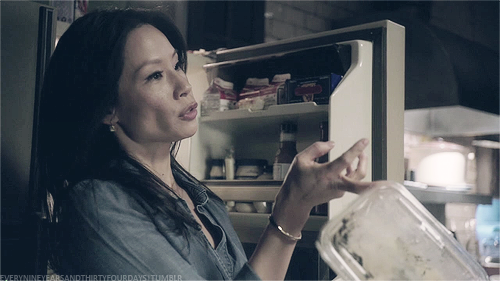
Holmes and Watson's complimentary outfits were out in fine form this week. My particular favourite was Lucy Liu's buttoned-to-the-neck Peter Pan collar shirt, which echoed Holmes' dorkish habit of buttoning all his shirts to the top but never wearing a tie. I'm now almost convinced that Holmes doesn't actually do laundry, but just donates his old clothes when they get dirty and buys some new ones from a bargain bin. In the light of this episode's focus on the wall-to-wall mess at Casa Holmes, this theory seems all the more likely.  

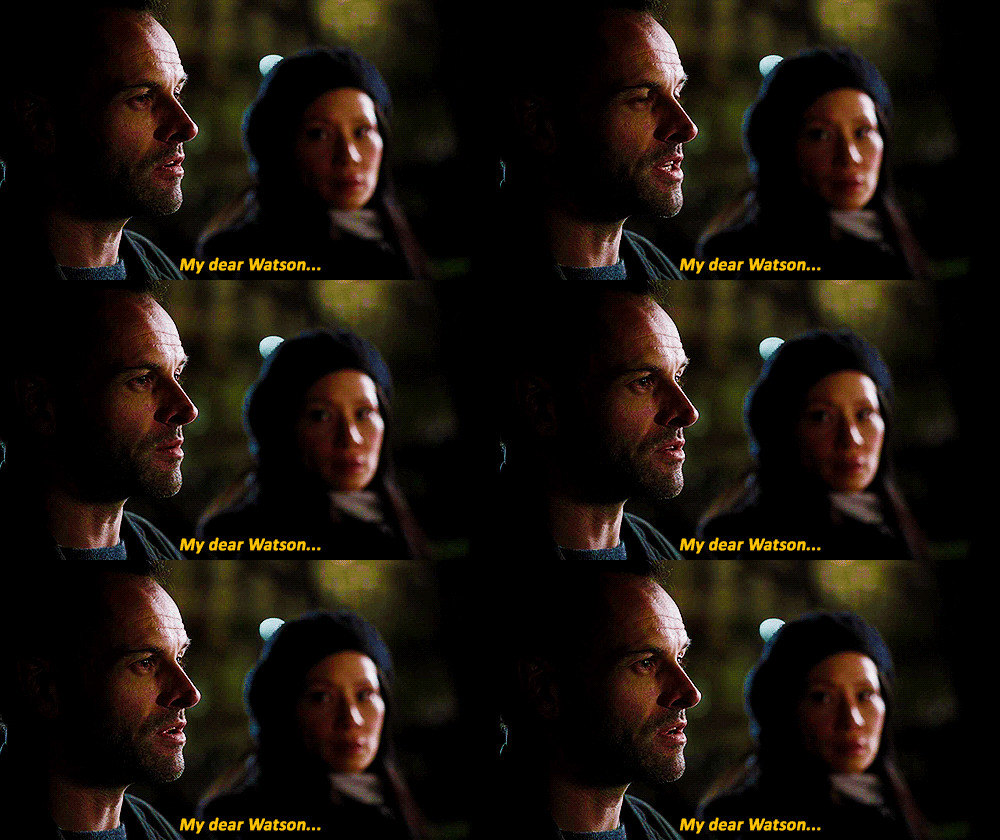
Dirty Laundry's Holmes/Watson interactions were particularly satisfying, mostly because Elementary is so unusual in its portrayal of Holmes and Watson's relationship in its tentative larval stages rather than launching straight into the I'd-die-for-you intensity of most Holmes adaptations. More than in previous episodes, we got to see the imbalance between Holmes' self-contradictory enthusiasm and Watson's professional distance. Joan is far more opaque and guarded than Sherlock whereas he, as someone who seems to have practically no experience with real friendship, looks like a kicked puppy as soon as she turns down his offer of a real partnership. Holmes is just so... sweet? Plus, he called her "My Dear Watson" for the first time! KILL ME.
source
Miscellaneous
  • ZERO violins or bees. Buck up, Elementary! 
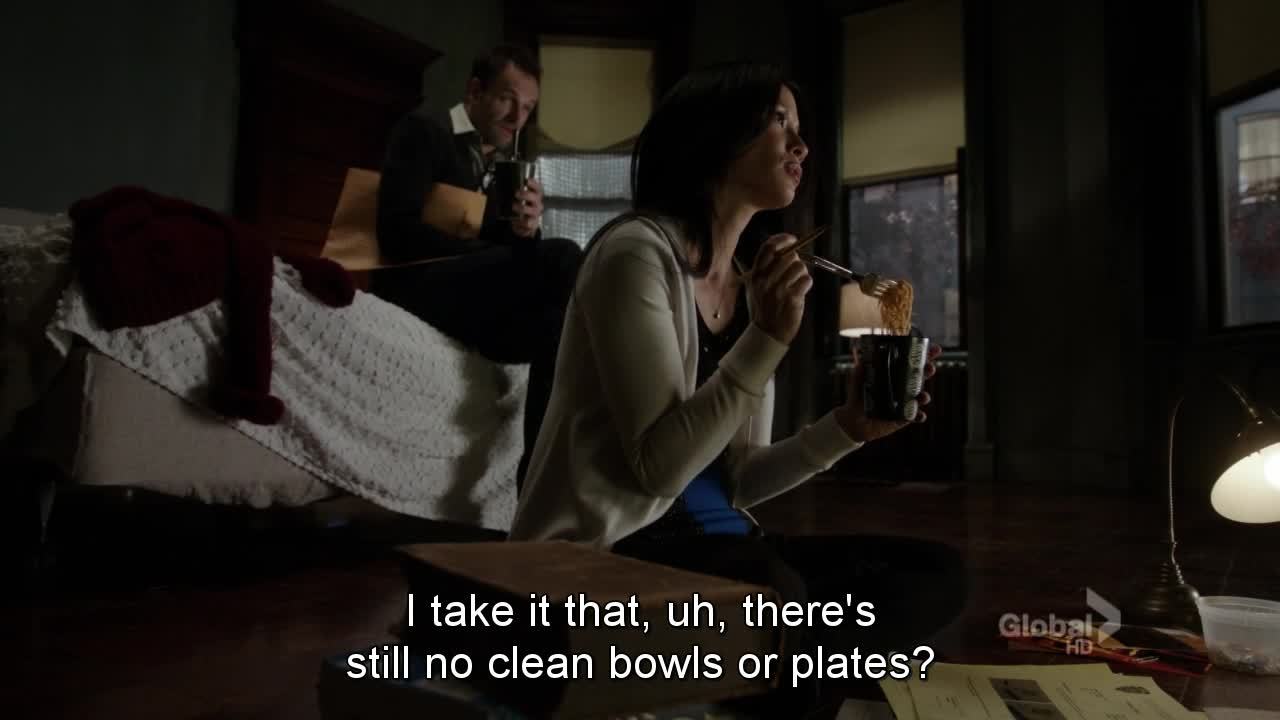
  • I L-O-V-E Watson steadfastly refusing to do any housework whatsoever on Holmes' behalf. 
  • Why can't the storytelling in this show be as good as the scriptwriting? Holmes gets at least ten pithy little zingers per episode, while the overall plots meander around in a confused bundle of red herrings and dead-ends. 
  • While I do remain unimpressed by mainstream American crime television's reliance on hooker jokes, I did enjoy Jonny Lee Miller's delivery of the phrase "whore-fishing".
  • Gird your loins, garters and accoutrements, because next week's episode is going to be featuring VINNIE JONES. The episode title is "M" and all signs point towards it either being about Moriarty or being a tremendous red-herring for Moriarty. I kind of almost want Vinnie Jones to be Moriarty because a) it's such a fascinatingly bizarre casting choice, and b) the reaction from the Elementary-hating wing of BBC Sherlock fandom would be so entertainingly horrified.
 Previous Elementary reviews. 
Read More
Posted in elementary, sherlock holmes, tv | No comments
Older Posts Home
Subscribe to: Posts (Atom)

Popular Posts

  • Master & Commander: The Far Side of the World. (Part 2)
    Previously: Master & Commander, Part 1. The characters in Master & Commander have a lot to say about the division between Navy and n...
  • Costuming & design in NBC's Hannibal: Hannibal Lecter's wristwatch.
    As part of my ongoing series on costume and design in Hannibal , I'm going to post my first guest blog with contributions from an outsi...
  • The costumes of X-Men: First Class, Part 2: Menswear.
    Part 1: Womenswear. OK, let's be real here. 99% of this section is gonna be about Erik and Charles, firstly because 99% of the movie is...
  • Costuming and Design in Captain America: The Winter Soldier -- Steve & Bucky.
    Part 1: "Trust No One" -- How Captain America became the gritty superhero we never knew we wanted. Part 2: HYDRA, Sitwell, and div...
  • Teen Wolf 2x09: Party Guessed.
    Previously: Teen Wolf 101: An introduction to the eighth wonder of our world . (Now available in audio as well!) Why does Teen Wolf hate ha...
  • Capitol Couture in The Hunger Games.
    It's a little late for a review of the Hunger Games movie itself, so in summary: I thought it was an excellent adaptation, and the few t...
  • The ultimate TEEN WOLF DRINKING GAME.
    OK, the midseason finale is upon us. After tonight, there's no more Teen Wolf until January 2014. To help you deal with the pain, I'...
  • Harry Potter, costume design, and wizarding fashion in 1920s New York. (Part 2)
    Previously: Part 1 . Most wizarding robes in the Harry Potter movies are a combination of bell-sleeved faux medieval robes, and old-fashion...
  • Teen Wolf: Tattoo.
    Previously: Teen Wolf 101: An introduction to the eighth wonder of our world . Welcome to Teen Wolf! The show where the shirts are off, and ...
  • The costumes of Alien. Part 1: Uniforms and characterisation.
    It took me until the ripe old age of 22 to see Alien, mostly because my mother warned me for years that it was the Most Terrifying Film Ever...

Categories

  • "it's historical"
  • 1920s
  • 1940s
  • 1950s
  • 2014
  • accessories
  • agent carter
  • agents of shield
  • alexander mcqueen
  • alexander wang
  • alien
  • alien quadrilogy
  • aliens
  • apocalypse fashion
  • armour
  • avengers
  • bad movies
  • bad reviews
  • batman
  • bbc
  • benedict cumberbatch
  • big bang press
  • books
  • captain america
  • chanel
  • china
  • chris kane
  • comics
  • constantine
  • conventions
  • cosplay
  • costume design
  • costumes
  • couture
  • dance
  • dc
  • dior
  • dior homme
  • doctor who
  • dolce and gabbana
  • duckie brown
  • duro olowu
  • dystopias
  • elementary
  • erdem
  • fall 2012
  • fall 2013
  • fanart
  • fandom
  • fanfiction
  • fashion
  • fashion week
  • fausto puglisi
  • figure skating
  • game of thrones
  • gareth pugh
  • givenchy
  • goth
  • gwyneth paltrow
  • haider ackermann
  • hannibal
  • harry potter
  • hugo awards
  • hunger games
  • interstellar
  • interviews
  • IRL
  • iron man 3
  • it's historical
  • james bond
  • jason wu
  • jean paul gaultier
  • jonathan saunders
  • jw anderson
  • karl lagerfeld
  • ladies in suits
  • links post
  • london
  • london fashion week
  • louis vuitton
  • marc jacobs
  • marketing
  • marvel
  • mary katrantzou
  • masterpost
  • mcu
  • mediocre
  • menswear
  • menswear fashion week
  • milan
  • movie costumes i have loved
  • movie costumes i have loved
  • movie reviews
  • movies
  • mugler
  • needs more gold
  • neil marshall
  • new york
  • nyfw
  • oscars
  • other writing
  • ozwald boateng
  • pacific rim
  • paris fashion week
  • peggy carter
  • penny dreadful
  • persional taste
  • person of interest
  • personal taste
  • peter pilotto
  • podcasts
  • prabal gurung
  • pre-fall 2012
  • pre-fall 2013
  • pre-spring
  • prometheus
  • punk
  • ralph lauren
  • rants
  • resort 2013
  • retrofuturism
  • revenge
  • rick owens
  • s/s
  • scandinavia
  • sci fi
  • sci-fi
  • scotland
  • set design
  • shakespeare
  • sherlock
  • sherlock holmes
  • SHIELD
  • shoes
  • snowpiercer
  • spring 2012
  • spring 2013
  • spring 2014
  • star trek
  • star trek into darkness
  • star wars
  • starfleet
  • stargate
  • stoker
  • street style
  • suits
  • superheroes
  • superman
  • supernatural
  • tailoring
  • teen wolf
  • the hour
  • the row
  • theatre
  • theyskens theory
  • thom browne
  • thor
  • thor 2
  • threeasfour
  • tom ford
  • tom hiddleston
  • tv
  • ulyana sergeenko
  • uniforms
  • upholstery
  • versace
  • victoria beckham
  • video post
  • viktor and rolf
  • vivienne westwood
  • walter van beirendonck
  • watches
  • writing
  • x-men
  • yohji yamamoto
  • zac posen

Blog Archive

  • ▼  2015 (4)
    • ▼  January (4)
      • Hugo Award eligibility & 2014 masterlist
      • Interview: Agent Carter costume designer Gigi Melton
      • Behind the seams of the Oscars' costume design cat...
      • A guide to 1940s costume design in Marvel's Agent ...
  • ►  2014 (38)
    • ►  December (3)
    • ►  November (3)
    • ►  October (3)
    • ►  September (1)
    • ►  August (1)
    • ►  July (3)
    • ►  May (1)
    • ►  April (8)
    • ►  March (4)
    • ►  February (2)
    • ►  January (9)
  • ►  2013 (68)
    • ►  December (2)
    • ►  November (2)
    • ►  October (7)
    • ►  September (9)
    • ►  August (5)
    • ►  July (9)
    • ►  June (6)
    • ►  May (4)
    • ►  April (3)
    • ►  March (5)
    • ►  February (11)
    • ►  January (5)
  • ►  2012 (122)
    • ►  December (6)
    • ►  November (11)
    • ►  October (11)
    • ►  September (13)
    • ►  August (9)
    • ►  July (12)
    • ►  June (13)
    • ►  May (8)
    • ►  April (6)
    • ►  March (7)
    • ►  February (13)
    • ►  January (13)
  • ►  2011 (32)
    • ►  December (8)
    • ►  November (10)
    • ►  October (13)
    • ►  September (1)
Powered by Blogger.

About Me

christofer D
View my complete profile