Why you need to watch Spanish Snow White movie ...

  • Subscribe to our RSS feed.
  • Twitter
  • StumbleUpon
  • Reddit
  • Facebook
  • Digg
Showing posts with label movie costumes i have loved. Show all posts

Wednesday, October 23, 2013

Only Lovers Left Alive: The one movie you MUST see next year.

Posted on 12:27 PM by christofer D
Note: There are no plot spoilers in this post! I was going to hold off until the movie was on general release, but apparently that's not until Spring 2014 and I just couldn't wait.

I can't overemphasise how much I loved this movie. For sheer entertainment value it's tied with Joss Whedon's Much Ado About Nothing for my favourite film of 2013, but it wins out in terms of sheer oddness and originality. The premise is already brilliant (Tilda Swinton! And Tom Hiddleston! As a pair of immortal vampire lovers!) but the plethora of promotional clips and images can't prepare you for what the film is actually like. Most notably, the fact that OLLA is genuinely -- and intentionally -- hilarious. I was lucky enough to see it at the BFI Festival in London this weekend, and the entire audience was laughing all the way through, often loud enough to drown out some of the dialogue. It's a delightful, sly kind of humour. Not remotely based on the kind of horror movie homage jokes you might expect from a movie that falls into the genre of "vampire romance".
Eve (Tilda Swinton) and Adam (Tom Hiddleston) in Tangier.
OLLA avoids almost all cinema tropes associated with vampires, which is pretty impressive when you consider that people have been making vampire movies since the birth of cinema. Obviously the film retains some essential aspects -- blood-drinking, avoidance of sunlight -- but they're treated quite casually. There's also a noticeable absence of the kind of sexual/romantic vampirism tropes we're used to seeing, with the main vampire characters acting less like voracious, eternally youthful predators, and more like lethargic intellectual shut-ins. The focus is on Adam and Eve's relationship, and how their lives are shaped by immortality.
At one point Eve's little sister Ava (Mia Wasikowska) tells Adam and Eve that they're snobs: an accurate but not necessarily insulting summation. Eve is constantly surrounded by books, and her best friend is Christopher Marlowe -- another vampire, heralded by multiple Shakespeare jokes because director Jim Jarmusch is a Marlowe conspiracy theorist in real life. When you're several centuries old, you can't really avoid becoming an intellectual elitist, with our immortal vampire protagonists becoming understandably condescending towards humanity. While the word "vampire" is never actually uttered onscreen, Adam refers to humans as "zombies", depressed by the repetitive nature of their stupidity and destructiveness. But despite all the ageless hipsterism, it's Adam and Eve's mutual love of knowledge and new experiences that keeps them going. This may be an undead romance that takes place entirely at night, but it's still a very warm and affectionate film. As Eve explains to her husband when he's feeling low, "Life is about appreciating nature, surviving things, nurturing friendship, kindness, and dancing."

Of course Only Lovers Left Alive is a romance: it's right there in the title. I just wish there were more love stories like this in mainstream cinema. I love romance, but most "romantic" movies either weigh me down with dismally stereotyped gender roles, or are way too serious and depressing. Both problems caused by the genre being seen as girly and frivolous, unless it's couched in hours of agony, betrayal, and deceit. OLLA is a story about two people who find each other endlessly charming and appealing, which is a bizarrely rare occurrence in romantic movies. Most of the time, love stories are told from the beginning, or during a time of upheaval and strife. But with Adam and Eve, we're just getting a glimpse into the middle of an incredibly longstanding and complex relationship that could potentially last forever.
In that way, it may be the most romantic movie I've ever seen. Both characters have this immense fascination with each other, but it's completely relaxed and balanced, each accepting the other's faults. Not to mention the comforting physicality between the actors, who spend most of the movie draped all over each other. They have chemistry in a way that's oddly difficult to describe, because it's so rare to see a movie where the central romantic couple just lie around on top of each other all the time without it turning into a sex scene. When I first saw the above image of Swinton and Hiddleston together I assumed it was a one-off, but in fact every one of their scenes is like that -- and somehow, it never becomes saccharine or awkward.

Adam
Apparently Jim Jarmusch sold this role to Tom Hiddleston as "Hamlet, as played by Syd Barrett", which I find pretty hilarious because that description is Tom Hiddleston catnip. The character is perfect for him: the ideal comedy role for an actor who's known for Shakespearean angst and tortured antiheroes. And yes, he's very funny. Both Eve and the film itself have this wonderfully affectionate yet mocking attitude towards his depressive, angsty nature. It's not exactly a parody of sad goth moping, but it's not far off. He is truly suicidal, and it's presented as a serious aspect of his character, but it's offset by the fact that he's the archetypal misanthropic artist. Lurking in a house full of antique musical instruments, he accidentally spurs on his own cult-like fanbase of music nerds by refusing to have any contact with the outside world.
It's a long time since I was in a fully fledged vampire phase, but I still retain a real love of gothic media. And believe me, this movie is as goth as they come. Adam lives in a deserted house on the outskirts of bombed-out Detroit, wears nothing but black, and languishes in a permanent state of emo sulk. He's a beautiful study of the reclusive artistic genius, his human hanger-on Ian (Anton Yelchin) constantly in awe of his effortless cool -- which is mostly generated by his impenetrably self-absorbed, depressive nature, and love of wearing dark glasses at night. There's a scene where he plays Paganini's Caprice No. 5 on violin, while wearing an antique velvet dressing gown. Good luck finding anything more beautifully gothic than that.

Eve
There are some famous actors who only ever play parts who look like themselves. The worst examples I can think of are Johnny Depp and Helena Bonham Carter, who both suffer from a combination of the Tim Burton Curse and having very eccentric dress sense in real life. Helena Bonham Carter's costumes in Les Miserables and The Lone Ranger are virtually identical to her clothes in real life, making it too difficult to differentiate between the actor and the character she's playing. And to a certain extent, Tilda Swinton does sometimes fall into that category. The difference is that she's a good enough actor to carry it off, even if there have been occasions when she dressed like Jadis the White Witch in real life. Her red carpet fashion choices may sometimes look like movie costumes, but that doesn't mean for a second that you don't wholly believe in her performance.
Eve's costumes were simultaneously Swintonesque and perfect for her onscreen character. Swinton likes to wear a lot of draped, tailored robes and suits, with an emphasis on fabric choices and very little reference to current fashion trends -- ie, very similar to Eve in terms of superficial appearance. Eve's clothes reflected her way of combining the timeless (embroidered robes) with the modern (pale suede skinny jeans), which contrasted with Adam's uniform of black jeans/black t-shirt, which he may well have been wearing for the past forty years. Their respective costume choices seemed to play around with the two characters' relationship with time, since Adam is (unintentionally) far more concerned with present-day events, while Eve sort of skates past without getting truly invested.
Eve's character may have superficial connections with the 21st century in the form of an iPhone and a modern-looking jacket, but being played by Tilda Swinton helps a great deal when it comes to seeming ageless and otherworldly. I also noticed that she looked a lot more contemporary in scenes when she'd be seen by humans, such as traveling on the plane (as a posh-looking middle-aged lady), or hanging out at a nightclub (where she and Adam wore their matching sunglaasses and leather gloves). Otherwise, she wears robes or gowns, unable to pin down to any fixed location or time period. Adam, on the other hand, is tied down by a huge collection of material possessions, obsessed with antique musical instruments and wearing clothes that immediately characterise him as a rock musician -- even if that's the one thing he doesn't want to be.
Aside from Adam and Eve, the rest of the costuming is minimal because the rest of the cast is minimal. Mia Wasikowska's character wears a girly babydoll dress that immediately sets her apart from the mature appearance of her sister Eve, while Anton Yelchin is a typical slouchy rocker dude, with a drawling voice to match. At one point John Hurt's Christopher Marlowe was supposedly wearing a 500-year-old waistcoat, but my favourite detail for his character was his crutches, which I believe (?) was a reference to the real Christopher Marlowe having a lame or broken leg.
If there's any justice in the world, Only Lovers Left Alive will end up with a serious cult following. Not only does it manage the near-impossible feat of being a fresh take on the vampire genre, but the worldbuilding is deliciously deep and rich compared to most movies aimed at a horror/fantasy audience. It really makes me wish that more so-called art filmmakers were willing to work with "genre" fiction rather than rejecting it as populist nonsense. Despite being a movie about culture snobs, OLLA disproves one of the favourite myths of current pop culture snobbery: that "paranormal romance" is purely the realm of shallow and frivolous storytelling. It's a complex and beautiful love story, blood-drinking and all.
Read More
Posted in costume design, movie costumes i have loved, movies | No comments

Friday, July 26, 2013

Why you need to watch Spanish Snow White movie "Blancanieves" AT ONCE.

Posted on 12:06 PM by christofer D
Blancanieves came out in 2012, but I figured that if I'd managed to miss it first time round, some of you guys might too. And you should definitely be watching this movie, because it's fantastic. Last year saw two major Snow White blockbusters come and go, and neither of them were good. I was obsessed with the badass-looking Snow White and the Huntsman until I actually saw it, and the reviews for Mirror Mirror were so bad that I didn't even bother -- despite the fact that the costumes were by Eiko Ishioka, one of the most talented designers in cinema history. Blancanieves, however, is perfect.
I confess, this post isn't for purely altruistic reasons: I want everyone to go and see this movie so I can get someone to write fanfiction about it. Because seriously, it's a black-and-white silent film about matadors. This is not going to get a vast quantity of traction online, outside of the Yuletide festival for obscure fanfic. So I need you to a) watch Blancanieves, b) fall in love with Blancanieves like I did, and c) nominate it as a Yuletide fandom this Christmas, so we can all share the love. OK?
Blancanieves is far, far better than the vast majority of supposedly "fairytale" movies I've seen in recent years, keeping the basic elements of the Snow White story but changing the setting to 1920s Spain. Snow White's mother dies in childbirth, leaving her father, a paralysed former bullfighter, alone with a predatory nurse -- the inevitable Evil Stepmother. But rather than growing up to be a flamenco dancer like her mother and grandmother, Snow White becomes a bullfighter. A bullfighter.
To someone who hadn't so much as watched the trailer, this development was beautifully unexpected. There is no "women can't be bullfighters!" journey, or really any of the kind of girl power tribulations one usually has to go through when a woman wants to do anything in Historical Times. Obviously in most films, the girl power tribulations are necessary and provide realistic conflict, but the fairytale nature of Blancanieves meant they could just get on with it. Sometimes, little girls are forced to live in the coal cellar by their evil, beautiful stepmothers. And sometimes they grow up to tour Spain in a caravan with a troupe of bullfighting dwarves. (N.B. The bullfighting stuff is not gory. I'm vegetarian and am very aware that bullfighting is The Worst, but in the context of this movie it was fine.)
There is no prince in Blancanieves, and I can't tell you how happy that made me. I love fairytales, and I love romance... but somehow, 90% of the movies that combine those two things end up being kind of a yawnfest, because they just recycle terrible old gender-rolesy tropes. Anyhow, Blancanieves is very obviously Snow White's story, and while it's thoroughly romantic, it isn't a Boy Meets Girl story. That being said, she does have a love interest: He's one of the dwarves. (See my previous points re: fanfic. I NEED SOMEONE TO WRITE ABOUT THIS. It's a very sweet love story.) Instead, much of the movie focuses on Snow White's relationships with her family: first her blood relatives, and then the dwarves.
This movie won about a gazillion awards, and rightfully so. Not only was it gorgeous, but it managed to tell a story about European circus(ish) performers in the 1920s without ending up as a Moulin Rouge-style pastiche. And the costumes were gorgeous. Honestly, this is the perfect story for black and white because so many fairytale good/evil tropes are already coded into the visuals. The evil stepmother is sumptuously gothic, combining the black of mourning with vampiric sexuality, while Snow White's pale skin and black hair are literally written into the story already. There's a beautiful moment when the young Snow White's brand new confirmation dress is dunked into a vat of black dye, readying her for a life of wearing black and living in her stepmother's coal cellar.
So, just to recap: Why you need to watch Blancanieves:
  • It somehow manages to be Bechdel-compliant without technically including a single line of dialogue.
  • A short-haired, bullfighting Snow White. 
  • A lovely and unconventional romance.
  • It's an old-school fairytale that combines creepiness with a simple, emotional storyline.
  • Beautiful, intricate 1920s Spanish costumes.
Postscript: I yearn for a matador suit. Yearn.
Read More
Posted in 1920s, movie costumes i have loved, movies | No comments

Sunday, July 14, 2013

The costumes of Pacific Rim.

Posted on 7:15 AM by christofer D
N.B. If you're here via Bleeding Cool, here is the masterlist of my costume design posts. I know a lot of my recent posts are about Teen Wolf, but I promise that most of the time, this is a costume design blog. ;) 
Dress For Success – An Analysis Of The Pacific Rim Costume Designs, for BleedingCool.com.


Pacific Rim may come across as a live-action anime, but the costumes are relatively down-to-earth. Set a little over a decade in the future, Guillermo del Toro ignored futuristic styles in favour of a mid-20th century aesthetic.

As an outspoken pacifist, del Toro was keen to remove any militaristic overtones from the movie. Hence the Jaeger crews all having ranks like “Marshall” and “Ranger”, and the general lack of a military aesthetic. The overall look of the movie is more wartime than warlike, with people bustling around either in civilian clothing or the grubby overalls of an airport hangar. Any uniforms we see are generally more like those worn by the crew of the Nostromo in Alien, rather than a military uniform with obvious ranks and a dress code. [READ MORE]

Read More
Posted in costume design, movie costumes i have loved, pacific rim, uniforms | No comments

Friday, May 31, 2013

The costumes of Stoker: A vampire movie without the vampires.

Posted on 11:00 AM by christofer D
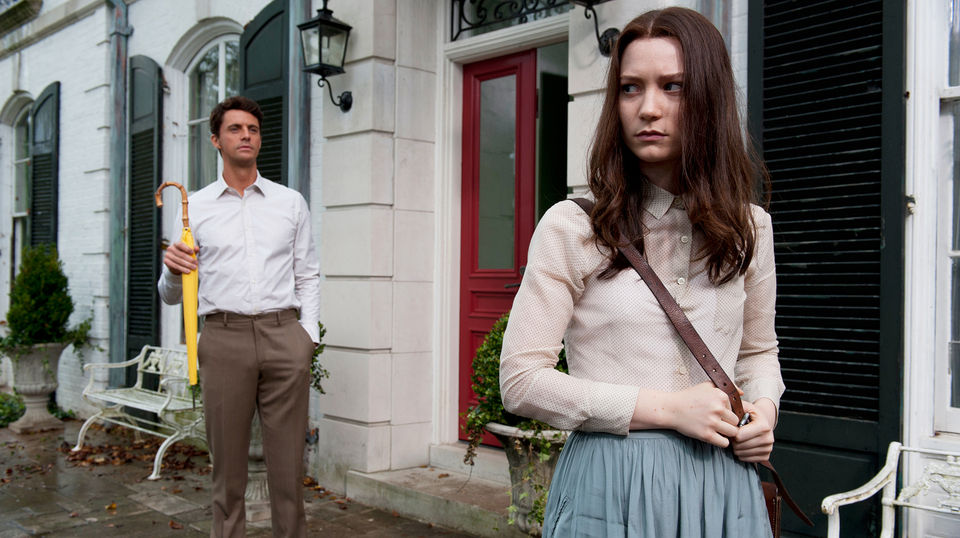
I've been watching a lot of Hannibal recently, and I've come to realise that Stoker could be the origin story for a female analogue to Hannibal Lecter. While there are plenty of psychotic male antiheroes out there, India Stoker is a rare breed: an ambiguously amoral female character who isn't depicted as a bitch, a slut, or a straight-up villain. Like Hannibal, Stoker is a vampire story without the vampires.
Stoker GIFs from here.
Stoker begins with the kind of premise that I generally find depressing: a mother/daughter love triangle, with the mother envying her daughter's youth. In this case it's Evelyn Stoker competing with her daughter India, who in true cliche spirit is "on the cusp of womanhood". Following the death of India's father Richard, long-lost uncle Charlie shows up at the funeral. Exploiting Evelyn's loneliness and India's sulky passivity, he moves into the Stokers' huge country house where he begins seduce both mother and daughter -- in very different ways.

Until we see her go to school, India's age isn't immediately clear. Mia Wasikowska's clean-faced appearance allows her to seem anywhere from mid-teens to late twenties, and India's living situation fails to provide many clues: one can easily imagine her and Evelyn growing old together in the Stoker house, Grey Gardens style. Her costumes are consciously frumpy and virginal: loose-fitting, Alice In Wonderland pinafore dresses and the flat-heeled saddle shoes that take on such important meaning later on in the film.
Clothes On Film has a great post about those shoes as a symbol of Charlie's obsessive desire to control India. He sends her a new pair every year, and thinking they were a gift from her beloved father, they're the only shoes India ever wears. In one scene she lies in bed, surrounded by seventeen years' worth of shoeboxes, and it's never quite clear whether she feels betrayed or intrigued when she finally discovers that they came from Charlie all along. India's shoes may also be a reference to Audrey Horne in Twin Peaks, whose transition from black-and-white saddle shoes to red high heels symbolises her journey from schoolgirl to seductive adult woman.
A lot of thought went into the costumes of Stoker. India is a Wednesday Addams figure, dressing like a child from another era while her mother wears a series of vampy, feminine designer outfits. One of my favourite scenes is when we finally see India leave the grounds of the Stoker house and go to highschool. Until then the film seems like it exists in an arthouse cinema bubble of stylised costumes and mannered colour palettes, but in fact it's only the Stokers who live there. As soon as India arrives at school, we realise that the movie is taking place in the "real" world after all, as the stubbornly bizarre (and now by comparison, utterly bizarre-looking) India goes to class alongside stereotypical 21st century jocks and teen girls.
Charlie's appearance is particularly disturbing because of its Stepford Husbandish attention to conventional detail. All of his clothes are a parody of preppy, all-American style, to the extent that subconsciously, you just know that it's a costume rather than being his "real" appearance. A wolf in WASP's clothing -- or a vampire in disguise. This feeling is exacerbated by the overt hints that despite his charm, he doesn't fit in with normal society -- for example, arriving at his brother's funeral without mourning clothes or even a black tie. Plus, because Charlie is meant to be an object of both fear (India) and desire (Evelyn), Matthew Goode is filmed in a way that mesmerisingly combines "horror movie monster" with "look at this hottie".
One of the reasons why I wrote this review (so long after the movie came out, that is) is the number of questions I've received about Stoker's costumes, particularly the colour-scheme. Charlie's yellow v-neck sweater is a far less noticeable costuming detail than India's shoes or her mother's luxurious formalwear, but it's still ripe for analysis. Charlie is an intriguing combination of two movie psycho stereotypes: charming, virile killers (Hannibal Lecter) and childish or sexually ambiguous weirdos (Norman Bates). As he charms Evelyn and lurks vampirically over India while she plays the piano, we can only interpret him as being in the first category. But as the film progresses, we learn that he also has a great deal in common with the less glamourous breed of onscreen serial killers -- the ones who sleep with a body-pillow of their mother, or collect creepy china dolls.
Charlie's monstrous nature is rooted in his childhood, and once we see the flashback scenes between him and Richard, it's easy to see him as being a partly childlike figure beneath that veneer of seductive American charm. The yellow sweater fits in with this characterisation: the colour of baby blankets, fluffy ducklings, or the kind of pastel shade associated with the implicitly queer villains of media from the mid-20th century. And as this post points out, the recurring colours of red and yellow are a noticeable theme in Stoker. From Charlie's yellow umbrella to India's bloodstained yellow pencil, both colours are in the foreground throughout.
In true vampire movies, the virginal girl's transformation into a bloodthirsty monster is usually signalled by a sudden fondness for corsets and sultry makeup -- a link to the vampire's metaphorical role as an experienced older man who inspires her sexual awakening. Stoker subverts this trope, with Charlie entering into a murderous pact with India before trying to seal the deal with a pair of crocodile skin stiletto heels. In his mind, the shoes are a symbol of him finally bringing India into the fold as his adult lover/fellow "vampire", but India rejects this in favour of going her own way. Rather than transforming into the sexy, aggressively stylish lady those crocodile heels represent, she ends up putting on her mother's blouse, her father's belt, and the shoes as an afterthought. A fitting finale, considering the fact that her style and personality are both a product of the incestuous nature of her family.
Related: Movie costumes I have loved: Hanna.
Read More
Posted in costume design, movie costumes i have loved, stoker | No comments

Friday, May 10, 2013

The evolution of the Star Trek uniform.

Posted on 10:15 AM by christofer D
Just in time for the new Star Trek movie, I wrote this article for Empire Online! It follows the original series Starfleet uniform from the 1960s to the present day -- but don't worry, there aren't any spoilers for Into Darkness. You can expect a post about that sometime next week, after the US release date. :)

Even Star Trek’s most devoted fans wouldn’t dare claim that the original series was a high-budget operation. In among the cardboard sets, guest stars had to wear a selection of costumes that ran the gamut from the baffling (an evil baby in a silver lamé toga; girls in hot-pink fur bikinis) to the plain ugly. In one early episode, an entire alien species is kitted out in a vaguely familiar fabric that one later realises is also used for all the bedspreads on-board the Enterprise.

But in the original series Starfleet uniform, Star Trek struck costuming gold. [READ MORE]

Read More
Posted in costume design, movie costumes i have loved, sci-fi, star trek, uniforms | No comments

Sunday, March 3, 2013

Costume design and movie/TV review masterpost.

Posted on 7:26 AM by christofer D
In an attempt to make Hello, Tailor easier to navigate, I try to update my masterpost every few months. This post obviously doesn't include every post on the blog, but if you feel a real yearning for reviews of catwalk shows from six months ago then feel free to faff around with the tags. Try stuff like fashion week for more general posts, or Spring 2012 for more specific timeframes. More recent fashion posts are also organised by designer, ie Chanel; Alexander McQueen. Aside from that, the rest of the blog is mostly dedicated to costume design and TV/movie reviews.
My favourite costume design posts can be found under the movie costumes I have loved tag, which begins with A fan's introduction to costume design. Otherwise, I've divided this masterpost into various movie and TV subcategories, which are probably easier to browse than my tags.

Movie costumes I have loved.

Master & Commander Part 1 and Part 2. 

Tinker Tailor Soldier Spy

Hanna

A Knight's Tale

True Romance

Doomsday

Skyfall: the costumes.

Superhero movies

The Marvel and comics tags are a good place to start, but here's a more conclusive rundown of my superhero posts:

Movie Costumes I Have Loved: Thor.

Movie costumes I have loved: Pepper Potts in the Iron Man franchise.

If there's no such thing as a vintage Captain America venereal disease PSA then I'm going to be so disappointed.

Some hopes and dreams for The Dark Knight Rises.

Avengers costume design posts: 

Pre-Movie Avengers post: Loki's costumes, armour, and image-consciousness.

The costumes and characters of The Avengers. Part 1: SHIELD. Part 2: Tony Stark, Pepper Potts, and Bruce Banner. Part 3: Steve Rogers, Captain America. Part 4: Black Widow and Hawkeye.

Iron Man 3 promo pics.


Alien series

The costumes of Alien. Part 1: Uniforms and characterisation. & The costumes of Alien. Part 2: Space suits, retrofuturism, and Prometheus.

The costumes of Aliens, or, James Cameron says Put A Gun On It.

Disturbing viral marketing for Prometheus: Happy birthday David, from Weyland Industries.

Prometheus: Proof that epic sci-fi doesn't belong in the Alien franchise.

Prometheus and the fannish mindset: Plotholes Aren't Everything.

Costume design and the crew of the Prometheus.


General movie posts.

The iconic menswear of James Bond.

Skyfall: Bond as a blunt instrument, and the new Bond Girls.

The new Judge Dredd movie is a great chick-flick.

Les Miserables: Seriously, Javert? Seriously??

The Hollow Crown series: Richard II & Henry IV, Part 1 & Henry IV, Part 2.

Bill Cunningham New York

Oswald Boateng: A Man's Story.

The Girl With The Dragon Tattoo, H&M, and the difficulties of marketing a female action heroine, and The Girl With The Dragon Tattoo review post.

Dressing For The Apocalypse: a guide to post-apocalyptic movie fashion.

Capitol Couture in The Hunger Games.

Snow White & The Huntsman: How to tell a fairy story. and Snow White & The Huntsman: The prince doesn't get the girl; the girl gets the kingdom.


TV shows

The Teen Wolf tag should lead to all Teen Wolf posts, beginning with Teen Wolf 101: A guide to the eighth wonder of our world.

The Elementary tag should lead to all Elementary posts, beginning with From Arthur Conan Doyle to New York City's "Elementary": The Costume Design of Holmes and Watson, and Elementary: characterisation, the unaired pilot, and its relationship to Sherlock Holmes canon.

Check the Doctor Who tag for posts about Doctor Who.

Person of Interest: The man in the suit. 

Costume design and The Hour: Freddie Lyons and Bel Rowley, Menswear, and Womenswear.

The Bletchley Circle (a female-led 1950s detective drama) and its costume design post.

The Revenge tag should lead to all Revenge posts, beginning with New style crush: Nolan Ross in REVEEEENNNGGE.

The Good Wife: Parenting Made Easy.

Star Trek's original 1965 pilot episode: The Cage.  

The Killing (AKA Forbrydelsen), and the iconic status of Sarah Lund's jumpers.

The most important thing about BBC Sherlock's "A Scandal In Belgravia".

Game Of Thrones: Unwashed Northerners, royal conspiracies, and decapitations all round.

Miscellany

One Direction, teenage Tumblr fandom, and how to stay safe and private online.

Honour Among Punks: Sherlock Holmes like you've never seen her before.

Star Trek Into Darkness teaser trailer theories.

Secret Avengers #1.

Neil Marshall set to direct "The Last Voyage of Demeter".

Girl Walk//All Day
 
Read More
Posted in costume design, masterpost, movie costumes i have loved, movies, tv | No comments

Wednesday, February 20, 2013

Person Of Interest: The man in the suit.

Posted on 12:36 PM by christofer D
Person Of Interest is three different genre shows stuck together. For Detectives Carter and Fusco it's a police procedural drama, whereas John Reese lives in a spy thriller and Harold Finch's story is gradually edging towards being a full-on dystopian cyberpunk sci-fi. Overall it's marketed as a crime show, more or less, which is what it mostly looks like on the outside. Like the majority of characters in procedural cop shows Carter and Fusco have very boring dress-sense, for practical and professional reasons. In costume design terms, the real interest lies with Finch and Reese.
Before I even saw the show, Reese had been described to me as a man who wears his clothes like a uniform. When he first appears he has nothing: no home, presumably no money, no real identity... until Finch comes along and sets him up with his very own apartment and a wardrobe full of identical black suits. Mysterious benefactors are a popular theme in fiction -- who doesn't wish a nameless billionaire would show up and randomly gift you with a new house? -- but Person Of Interest has a refreshing way of tackling the subject. Rather than twisting himself up in knots about receiving so much help from a total stranger, Reese just takes it.

What with his CIA training, subsequent betrayal, homelessness and total lack of friends or family, Reese is a man who has been stripped down to his bare bones. The things that normal people care about just do not bother him any more. Actually, Finch is like that as well, but for him it's more because he's been elevated beyond ordinary society thanks to his wealth, genius, and devotion to the Machine. With Reese there are scenes in almost every episode where you see him just fail to react to things that would have any normal person shying away in discomfort.
He doesn't care about people touching him or getting in his personal space. He doesn't care about money. He doesn't care about being watched and tracked constantly via CCTV. He doesn't care about getting beaten up, except in the sense that it's an inconvenience. When Finch picks him out of the gutter and sets him up in an enormous loft apartment with his own private arsenal, the only thing Reese is openly thankful for is that Finch has given him a purpose again. When you get right down to it, the only thing he really cares about is efficiency, which is why he wears the same outfit every single day of his life -- barring necessary disguises. Not having to think about clothes or look in the mirror every morning just removes another obstacle between him and his mission.
From a purely practical standpoint, Reese's monochromatic wardobe of identical suits is a stroke of genius. For all that you can compare the John Reese/Harold Finch duo to Batman and Bruce Wayne, Reese's main strength lies in his complete lack of distinguishing features. Although he's definitely good-looking enough to get by with a little superficial charm when the need arises, Reese is forgettable enough to be the perfect spy. The fact that his nickname during the police manhunt was "the man in the suit" tells you all you need to know, because as soon as he changes out of the suit? They don't even have a physical description. The sheer boringness of the outfit just amplifies how forgettable he can be, never mind how ridiculously easy it is to get into almost anywhere when you're a white, middle-aged man in a suit.
Finch's attitude to clothes is the polar opposite of Reese. Just by looking at him you can tell that he really enjoys dressing up -- even before you find out that he's a tailoring nerd. While Reese dresses to look as forgettable and generic as possible, Finch dresses for himself. Despite the fact that he spends most of his time alone in a disused library, he wears a three-piece suit almost every day, often including a pocket square. He definitely has different grades of suits, though. When he's just going to be sitting in front of a computer he wears softer, more comfortable outfits in warm colours like brown and maroon, whereas on days when he's going undercover in one of his millionaire personas he wears suits that are more obviously businesslike and luxurious in appearance.
Both Finch and Reese's suits have been cleverly matched up to the physical appearance intended for each character. Jim Caviezel, who is in reality beginning to look rather thicker around the middle than is ideal for a elite special-forces agent, looks far slimmer in his black suits than in anything else he wears on the show. His jackets are very rarely buttoned, both because an open jacket allows for more flexibility during fight scenes and because it's far more flattering to Caviezel's broad-shouldered frame. Finch's suits are typically quite soft by contrast and the waistcoats make him look a little rounder, which fits in with his list of harmless, birdlike cover identities: Finch, Crane, Wren, Partridge. Like most stories that focus on a partnership, the two characters have to balance each other out. While brains/brawn would be an unfair description considering Reese's skill as a tactician, it's certainly the case that much of Reese's strength lies in his ability to physically intimidate, whereas Finch relies on people mistaking him for the boring, fussy middle-aged man he appears to be.

Read More
Posted in costumes, menswear, movie costumes i have loved, person of interest, suits, tv | No comments

Thursday, February 14, 2013

Womenswear and The Hour.

Posted on 9:44 AM by christofer D
Previously:  Bel Rowley and Freddie Lyon & Menswear and The Hour.

As a kind of doomed swansong for The Hour's recent cancellation, here's the third and final part of my series of costume posts.

Marnie is absolutely the classic stereotype of 1950s womanhood. In season 1 she doesn't get much to do, but by season 2 Hector's terrible behaviour has shaken her up enough that she transforms into what I can only really describe as a 2010s-style ultra-femme liberated woman. Probably my favourite detail of this was the fact that she clearly had an affair at some point, but it was so subtle that we'll never really know who with. With any other character I'd dismiss this as meaning they didn't have enough time to include it onscreen, but with Marnie you know that it's because she's just so damn discreet -- unlike Hector, whose affairs are all an unmitigated disaster and end up splashed all over the tabloids.
Marnie dresses like confectionary every day of her life. She's terrifyingly put-together, at first because she's a rich young aristocrat and has nothing else to do except look good, and later because she'll be damned if she'll let things slide just because she's done the unthinkable and got herself a career. I particularly loved her super-coordinated pink swirling skirts and aprons for when she was appearing on television -- in black and white. In some ways Marnie can look a little cartoonish because of her permanent glossy smile and carefully arranged layers of brightly-coloured skirts and petticoats, but the fact is that the fashionable colour palette in the 1950s was a lot brighter than nowadays. Meaning that oddly enough, Marnie's candy-coloured costumes are actually more realistic than Bel's skin-tight businesswear.

Sissy is a relatively minor character, but her costumes are so good she draws the eye whenever she appears onscreen. To me, Sissy looks a lot like a modern woman dressing up in retro/vintage styles, because she's so incredibly on-trend while still wearing the kind of widely available working-class clothes that show up in vintage stores in the 21st century. Marnie's brand of femininity is such that she wears pretty much nothing but frothy, full-skirted dresses, which is actually a look that shows up at weddings and upper-crust social functions even today. Essentially, the idea of what we think of as super-feminine formalwear has not really changed in about sixty years. Sissy is part of the next generation of fashion-conscious girls, following inner-city London trends, going to mixed-race nightclubs and moving in with their boyfriends before they get married. Sissy wouldn't look out of place in Camden in 2013.
Freddie's wife Camille is kind of the flip side of Sissy. They're both very modern, young and trendy, but Camille represents the hipster (in the old sense of the word) beat-generation side of 1950s pop culture. She wears men's sweaters and is a member of the fledgling Campaign for Nuclear Disarmament. She and Freddie live in an unfurnished flat in a neighbourhood run by a Rachman-esque slumlord. Camille's main role in the show is to introduce some conflict into the Bel/Freddie story, so we only ever really see her in a negative light. I suspect they gave her less screentime on purpose, because the more we saw of her the more likely we'd be to empathise with her. She moved to another country to be with her husband, but as soon as they arrived he transformed from a cool, poetry-loving bohemian into a BBC workaholic who clearly has some kind of ongoing thing with his female best friend. Really, Camille is better off without Freddie.
source
It's difficult to pick out a favourite character from The Hour because everyone is just so brilliant, but if I had to choose one I'd go for Lix Storm. I can't even just call her "Lix", it has to be LIX STORM all together: the coolest name for the coolest lady. In season 1 she was mostly a side-character, providing pithy commentary and drinking at two in the afternoon ("Whisky is God's way of telling us he loves us and wants us to be happy."), but her season 2 plotline with Peter Capaldi's Randall Brown was one of the most gripping aspects of the show. 
Lix has some of my favourite character-based costume design on the show. She dresses in a purposefully masculine way, to the extent that some of her suits are a direct analogue for menswear. In a show full of well-written female characters, this isn't the two-dimensional indicator of tough womanhood that it might've been in another show. Instead, it's a nod to her backstory. In her role as a kind of surrogate mother/mentor figure to the younger people at The Hour, Lix is the voice of experience -- and the voice of the past. She's a war reporter who was on the ground, alone, during the Spanish Civil War. And unlike Bel and Freddie, she can remember WWII from an adult perspective. Lix's dress-sense is stuck in the 1940s, when for practical purposes womenswear fashions skewed more towards masculine styles. Even though she's working in an office in central London in the 1950s, she's still dressed as an on-the-ground reporter ten years in the past.
If we're going to get over-analytical here, I'd say that in the offices of The Hour, Lix, Bel and Sissy represent three different generations of women in the workplace. Similarly, we see three generations of womenswear on the show. Lix is the practical wartime woman, wearing a limited selection of simple, durable shirts and trousers, whereas Marnie is the postwar New Look woman who dresses as girlishly as possible in reaction to the clothes rationing and utilitarian styles of the 1940s. Sissy and Camille are both edging towards the 1960s, with Sissy representing the working-class trends that would rule the later decades of the 20th century, and Camille representing the counterculture.

Previously:  Bel Rowley and Freddie Lyon & Menswear and The Hour.

Petition to save The Hour.
Read More
Posted in 1950s, bbc, costumes, movie costumes i have loved, the hour | No comments

Monday, December 3, 2012

Costume design and "The Hour": Bel Rowley and Freddie Lyon.

Posted on 10:35 AM by christofer D
(N.B. This post is mostly about costumes so I've tried to keep it as spoiler-free as possible. There are a couple of minor characterisation spoilers, but nothing plot-related for either season.)

I recently mainlined the entire six-episode first season of The Hour, and it quickly rocketed to the top of my list of Best Historical Dramas Ever. Basically, it is flawless. I think it's fair to say that I'm pretty easy when it comes to overtly feminist historical dramas, but while The Bletchley Circle is great, The Hour goes a lot deeper than a three-episode crime show could ever manage. On top of working with the intriguing premise of the birth of TV journalism, the main characters are all beautifully three-dimensional and interact with the same levels of humour and emotional complexity as seen in The Good Wife. 
I love the way The Hour manages to integrate an obsessive attention to historical detail with a few necessary elements of romanticisation. They sourced period-specific pencils for the characters to use on set, but at the same time the basic concept of the show relies upon a 28-year-old woman being the producer of the BBC's flagship news programme. Obviously in 1956 this would be impossible but The Hour makes it effortlessly believable, and Bel's relationship with the two male leads -- Freddie the writer and Hector the presenter -- is the heart and soul of the show. As for historical detail, The Hour bears most of the hallmarks of a classic thriller about journalism, censorship and government conspiracies, and the topics Freddie and Bel investigate are very well chosen. The first season focuses on Cold War paranoia in London while the Suez Crisis rages on overseas, and I'm already obsessed with the amount of historical detail going in the background of season 2. Freddie, Bel and Hector are currently looking into corruption and vice in Soho, and we're already starting to see hints of Rachmanism and precursers to the Profumo Affair -- even though in 1957, all that was still unknown to the general public.
The mid-50s are a great period for costume design because this was the point when personal style really became A Thing, particularly for women. As well as the classic image of the 1950s housewife with her wardrobe of  frothy skirts and brightly-coloured cocktail dresses, this was the advent of fashions specifically aimed at women in the workplace. And while most of the main characters in The Hour are career-driven adults, there are still occasional appearances from 1950s teen subcultures like Teddy Boys or leather-clad rockers. It's interesting to look at the aesthetic of The Bletchley Circle and compare it to The Hour, since both seem authentic and yet are so obviously different. The Bletchley Circle takes place four years earlier than The Hour and the characters are still rooted in the styles of wartime rationing, so they look very drab when compared to richer and more image-conscious women like Bel Rowley or Marnie Madden.
Bel's costumes run to a strict work uniform of form-fitting pencil skirt suits and brightly coloured jersey dresses. She actually has a couple of near-identical outfits in block colours, indicating that she knows what suits to her and sticks to it. A practical consideration, when you remember that she works in the relatively conservative environment of the BBC in 1956. Obviously Bel wants to look good but there are no hints of frivolity in her appearance, for all that she's usually colourful and eye-catching. Outside work we only really see her wearing vampy cocktail dresses, which she suits amazingly well because Romola Garai has such a great hourglass figure. Unlike a lot of the other female characters she doesn't often wear makeup, and there are several scenes where we see her changing outfits very quickly -- the benefits of an efficient capsule wardrobe, as it would nowadays be called. Bel enjoys the effects of looking attractive and stylish, but doesn't really "dress up" in the same way girlier characters like Marnie Madden do. In fact she has what could be interpreted as a traditionally masculine attitude towards dressing, since she basically constructed her own equivalent of the formulaic suits her male colleagues wear every day.
When it comes to costuming, Freddie and Bel are a real odd-couple pair. In season 1 Freddie's slightly scruffy appearance is all part of his role as a maverick at the BBC, and indicates his refusal to buy into the kind of conventionality Hector Madden effortlessly represents. Ben Whishaw's skinny frame lends itself well to gawkiness and youth, but Freddie is far from nervous. In fact he's kind of a bantamweight fighter, doggedly following dangerous stories well after any other journalist would have compromised or given up. Also, in the first season a lot more emphasis is put upon Freddie's attitude towards social class, both because he's far more sensitive to class differences at this point and because the main storyline is so closely tied up in the lifestyle of the British aristocracy.
Freddie comes from a working-class background but is heavily influenced by his time as an evacuee with the aristocratic Elms family, and by his friendship with the upwardly-mobile Cambridge graduate Bel. He wears a shirt and tie because that's the only real option for a man who works in an office in the 1950s, but aside from that he quite openly doesn't care about fashion or style. Next to the handsome and well-tailored Hector Madden he looks unapologetically weedy and unkempt, something I suspect Freddie is oddly proud of. Wearing ill-fitting trousers and sweater-vests, he knows to his bones that he's different from all the rich and powerful people he writes about at work. There's one particular scene I remember from when Bel and Freddie spent a weekend at the country house of Hector's extremely upper-class wife, Marnie. They're given a full schedule grouse-shooting and dinner parties, for which Freddie is unashamedly unprepared. In the end Hector makes him borrow a full black-tie outfit, which of course swamps Freddie and makes him look like a Dickensian waif. This is a familiar trope in British costume dramas, most recently seen in Downton Abbey when a former chauffeur is scorned for showing up to dinner wearing an ordinary suit.
Freddie changes a lot between seasons 1 and 2, maturing past the kind of reverse snobbery he espoused when he first met Hector. At first, Freddie's constant state of mild dishevelment highlighted the differences between himself and Hector's classically handsome, well-to-do appearance. Interestingly, Hector probably put less thought into his appearance than Freddie did into his purposeful lack of style, since Hector not only has a wife who picks out his clothes for him, but he also has a backstage crew making sure he looks good enough for television. As for basic elements of personal grooming, Hector was in the army and probably went to boarding school, so his general neatness and devotion to masculine style conventions would have been drilled into him from a young age. At first Freddie rebels against all the things that a good suit and neat hair represent, but in season 2 he returns with greater confidence and different priorities -- and, for the first time, is in front of the cameras on a regular basis. The shabby cardigans are replaced with closely-tailored suits that actually fit his slim frame, and he mostly restrains himself to a rather subdued palette.
Continued in the Menswear of The Hour.
Read More
Posted in 1950s, bbc, costumes, it's historical, movie costumes i have loved, the hour, tv | No comments

Tuesday, November 27, 2012

Master & Commander: The Far Side of the World. (Part 2)

Posted on 10:58 AM by christofer D
Previously: Master & Commander, Part 1.

The characters in Master & Commander have a lot to say about the division between Navy and non-Navy sailors, whether it's out loud in dialogue or implicitly through their costuming. The final battle of the movie hinges upon the HMS Surprise being mistaken for a whaling ship, a ruse which is helped along by the recent addition of some former whalers to the crew. The idea of a Navy ship being neat and organised is so ingrained that their "disguise" is merely to seem messier and less competent than usual, and for the officers to wear brown oilcoats over their uniforms. For the everyday crewmembers, the task of upholding the image of the British Empire is to keep the ship running as cleanly and smoothly as possible; for the officers, it's to maintain an appearance of upstanding British aristocracy even in the middle of a storm.
The finest example of the British Seafaring Gentleman archetype in Master & Commander is, surprisingly, not Captain Aubrey. In fact it's one of the midshipman, Peter Calamy. Calamy is the most well-respected of the midshipmen -- experienced enough to be a good leader, but still young enough to be idealistic. With his short hair, sideburns and long trousers he definitely falls into the category of the proto-Victorian gentlemen, and unlike the younger midshipmen he's relatively clean and kempt. By contrast, Aubrey looks a lot more 18th century and careworn, and has clearly relaxed with age. Most of his clothes are old and worn, and in private he regularly strips down to stained shirtsleeves and knee-breeches. 

Aubrey's second in command, Tom Pullings, falls somewhere between Aubrey and Calamy. Pullings is an established officer in his own right, meaning that M&C isn't really "his" film and far more screentime goes to the aging hero (Aubrey) and the various coming-of-age stories of the midshipmen. In style he generally takes after his role-model Aubrey, with long hair and relatively traditional dress, but I'd say he's neater and more put-together -- which may partly be down to his role onboard ship. Since Aubrey's method of leadership is rather paternal and flexible, Pullings has to be more by-the-book in order to balance things out. The most interesting thing about Pullings' costuming is his bicorn hat, which he wears "fore-and-aft" in contrast to Aubrey's "athwartships" style. Athwartships was the style favoured by the older generation, modelled off Nelson's style, and this type of variation within the uniform is a clear sign of how much Naval uniforms were influenced by changing fashions.
I find it interesting, the way men's fashions and the value of personal style are so evident in this movie. Most of the officers take pride in their appearance even if only out of societal pressure, but it's a type of vanity that doesn't really have a modern equivalent -- particularly among men. These are 19th-century men who are influenced by 19th-century dandyism, even if they aren't dandies themselves. Being clean and well-turned-out was associated with things that don't necessarily have anything to do with fashion these days: patriotism, manliness, aristocracy, and competence. It's often the case that a character will be mocked for seeming too prissy or obsessed with their appearance (for example, the pastel-coloured Naval officers and East India Trading Company men in Pirates of the Caribbean), but I feel like the attitudes expressed in Master & Commander are far truer to life than that. These men aren't trying to impress women (because there aren't any), they aren't really trying to impress each other (because there's no privacy onboard ship, so everyone sees each other at their worst), and they certainly aren't keeping up with a strict uniform code as in the modern military. They're just living up to a set of standards that don't exist in modern society.
While the crew of the Surprise are somewhat ragtag and the officers are governed by the twin masters of 19th century fashion and the Naval uniform code, Paul Bettany's Dr Maturin is very obviously a civilian -- and very obviously unconcerned with Naval ideals of masculinity and Britishness. I'm not overly familiar with the original Aubrey/Maturin novels, but I do know that Maturin is the character who changed most between the books and the film. Although in M&C he's still an Irishman, his history as a spy and a laudanum addict is erased, as are his extreme levels of scruffiiness when compared to the other Gentlemen onboard the Surprise. Instead his lack of seamanship is emphasised, both in terms of his total lack of interest in sailing and in his many philosophical differences with dyed-in-the-wool Navy men like Aubrey.
The relationship between Aubrey and Maturin is the focal point of the film, with the unusually forward-thinking Maturin providing the audience with an outsider's view of Navy life. As a scientist and a rationalist, Maturin is a kind of Spock figure to Aubrey's Captain Kirk, since much of Aubrey's skill as a captain comes down to instinct and experience. Because he's the ship's doctor and the captain's closest friend, Maturin gets a lot of leeway when it comes to eccentricity, but he still wouldn't get away with the way he acts unless he also had the respect of the crew. The main reason he's allowed to dress and behave the way he does is because he's the only real civilian onboard, and therefore doesn't have to fit in with the crew or with the strict upper-class guidelines of the officers.
While he isn't as unkempt as his print counterpart, Paul Bettany's Maturin still bears very few signs of a 19th century gentleman's interest in fashion. He has no time for masculine posturing, and when it comes to his appearance he's something of an eccentric-intellectual stereotype -- all shabby waistcoats and old coats. Probably as a concession to the movie's 21st-century audience, Maturin's periwig has been traded in for a distinctly modern (well, Victorian) hairstyle. His most unusual outfit is the one he wears while exploring the Galapagos islands: a patterned banyan robe, a straw hat, and lace-up leather spats. It's an interesting combination: old-fashioned knee-breeches like Aubrey, coupled with the distinctly casual and unpatriotic addition of an Indian-style overcoat that has little in common with the more formal Naval fashions of the day.

Click here for more Movie Costumes I Have Loved.
Read More
Posted in costumes, it's historical, movie costumes i have loved, uniforms | No comments
Older Posts Home
Subscribe to: Posts (Atom)

Popular Posts

  • Master & Commander: The Far Side of the World. (Part 2)
    Previously: Master & Commander, Part 1. The characters in Master & Commander have a lot to say about the division between Navy and n...
  • Costuming & design in NBC's Hannibal: Hannibal Lecter's wristwatch.
    As part of my ongoing series on costume and design in Hannibal , I'm going to post my first guest blog with contributions from an outsi...
  • The costumes of X-Men: First Class, Part 2: Menswear.
    Part 1: Womenswear. OK, let's be real here. 99% of this section is gonna be about Erik and Charles, firstly because 99% of the movie is...
  • Costuming and Design in Captain America: The Winter Soldier -- Steve & Bucky.
    Part 1: "Trust No One" -- How Captain America became the gritty superhero we never knew we wanted. Part 2: HYDRA, Sitwell, and div...
  • Teen Wolf 2x09: Party Guessed.
    Previously: Teen Wolf 101: An introduction to the eighth wonder of our world . (Now available in audio as well!) Why does Teen Wolf hate ha...
  • Capitol Couture in The Hunger Games.
    It's a little late for a review of the Hunger Games movie itself, so in summary: I thought it was an excellent adaptation, and the few t...
  • The ultimate TEEN WOLF DRINKING GAME.
    OK, the midseason finale is upon us. After tonight, there's no more Teen Wolf until January 2014. To help you deal with the pain, I'...
  • Harry Potter, costume design, and wizarding fashion in 1920s New York. (Part 2)
    Previously: Part 1 . Most wizarding robes in the Harry Potter movies are a combination of bell-sleeved faux medieval robes, and old-fashion...
  • Teen Wolf: Tattoo.
    Previously: Teen Wolf 101: An introduction to the eighth wonder of our world . Welcome to Teen Wolf! The show where the shirts are off, and ...
  • The costumes of Alien. Part 1: Uniforms and characterisation.
    It took me until the ripe old age of 22 to see Alien, mostly because my mother warned me for years that it was the Most Terrifying Film Ever...

Categories

  • "it's historical"
  • 1920s
  • 1940s
  • 1950s
  • 2014
  • accessories
  • agent carter
  • agents of shield
  • alexander mcqueen
  • alexander wang
  • alien
  • alien quadrilogy
  • aliens
  • apocalypse fashion
  • armour
  • avengers
  • bad movies
  • bad reviews
  • batman
  • bbc
  • benedict cumberbatch
  • big bang press
  • books
  • captain america
  • chanel
  • china
  • chris kane
  • comics
  • constantine
  • conventions
  • cosplay
  • costume design
  • costumes
  • couture
  • dance
  • dc
  • dior
  • dior homme
  • doctor who
  • dolce and gabbana
  • duckie brown
  • duro olowu
  • dystopias
  • elementary
  • erdem
  • fall 2012
  • fall 2013
  • fanart
  • fandom
  • fanfiction
  • fashion
  • fashion week
  • fausto puglisi
  • figure skating
  • game of thrones
  • gareth pugh
  • givenchy
  • goth
  • gwyneth paltrow
  • haider ackermann
  • hannibal
  • harry potter
  • hugo awards
  • hunger games
  • interstellar
  • interviews
  • IRL
  • iron man 3
  • it's historical
  • james bond
  • jason wu
  • jean paul gaultier
  • jonathan saunders
  • jw anderson
  • karl lagerfeld
  • ladies in suits
  • links post
  • london
  • london fashion week
  • louis vuitton
  • marc jacobs
  • marketing
  • marvel
  • mary katrantzou
  • masterpost
  • mcu
  • mediocre
  • menswear
  • menswear fashion week
  • milan
  • movie costumes i have loved
  • movie costumes i have loved
  • movie reviews
  • movies
  • mugler
  • needs more gold
  • neil marshall
  • new york
  • nyfw
  • oscars
  • other writing
  • ozwald boateng
  • pacific rim
  • paris fashion week
  • peggy carter
  • penny dreadful
  • persional taste
  • person of interest
  • personal taste
  • peter pilotto
  • podcasts
  • prabal gurung
  • pre-fall 2012
  • pre-fall 2013
  • pre-spring
  • prometheus
  • punk
  • ralph lauren
  • rants
  • resort 2013
  • retrofuturism
  • revenge
  • rick owens
  • s/s
  • scandinavia
  • sci fi
  • sci-fi
  • scotland
  • set design
  • shakespeare
  • sherlock
  • sherlock holmes
  • SHIELD
  • shoes
  • snowpiercer
  • spring 2012
  • spring 2013
  • spring 2014
  • star trek
  • star trek into darkness
  • star wars
  • starfleet
  • stargate
  • stoker
  • street style
  • suits
  • superheroes
  • superman
  • supernatural
  • tailoring
  • teen wolf
  • the hour
  • the row
  • theatre
  • theyskens theory
  • thom browne
  • thor
  • thor 2
  • threeasfour
  • tom ford
  • tom hiddleston
  • tv
  • ulyana sergeenko
  • uniforms
  • upholstery
  • versace
  • victoria beckham
  • video post
  • viktor and rolf
  • vivienne westwood
  • walter van beirendonck
  • watches
  • writing
  • x-men
  • yohji yamamoto
  • zac posen

Blog Archive

  • ▼  2015 (4)
    • ▼  January (4)
      • Hugo Award eligibility & 2014 masterlist
      • Interview: Agent Carter costume designer Gigi Melton
      • Behind the seams of the Oscars' costume design cat...
      • A guide to 1940s costume design in Marvel's Agent ...
  • ►  2014 (38)
    • ►  December (3)
    • ►  November (3)
    • ►  October (3)
    • ►  September (1)
    • ►  August (1)
    • ►  July (3)
    • ►  May (1)
    • ►  April (8)
    • ►  March (4)
    • ►  February (2)
    • ►  January (9)
  • ►  2013 (68)
    • ►  December (2)
    • ►  November (2)
    • ►  October (7)
    • ►  September (9)
    • ►  August (5)
    • ►  July (9)
    • ►  June (6)
    • ►  May (4)
    • ►  April (3)
    • ►  March (5)
    • ►  February (11)
    • ►  January (5)
  • ►  2012 (122)
    • ►  December (6)
    • ►  November (11)
    • ►  October (11)
    • ►  September (13)
    • ►  August (9)
    • ►  July (12)
    • ►  June (13)
    • ►  May (8)
    • ►  April (6)
    • ►  March (7)
    • ►  February (13)
    • ►  January (13)
  • ►  2011 (32)
    • ►  December (8)
    • ►  November (10)
    • ►  October (13)
    • ►  September (1)
Powered by Blogger.

About Me

christofer D
View my complete profile