Why you need to watch Spanish Snow White movie ...

  • Subscribe to our RSS feed.
  • Twitter
  • StumbleUpon
  • Reddit
  • Facebook
  • Digg
Showing posts with label 1950s. Show all posts

Thursday, February 14, 2013

Womenswear and The Hour.

Posted on 9:44 AM by christofer D
Previously:  Bel Rowley and Freddie Lyon & Menswear and The Hour.

As a kind of doomed swansong for The Hour's recent cancellation, here's the third and final part of my series of costume posts.

Marnie is absolutely the classic stereotype of 1950s womanhood. In season 1 she doesn't get much to do, but by season 2 Hector's terrible behaviour has shaken her up enough that she transforms into what I can only really describe as a 2010s-style ultra-femme liberated woman. Probably my favourite detail of this was the fact that she clearly had an affair at some point, but it was so subtle that we'll never really know who with. With any other character I'd dismiss this as meaning they didn't have enough time to include it onscreen, but with Marnie you know that it's because she's just so damn discreet -- unlike Hector, whose affairs are all an unmitigated disaster and end up splashed all over the tabloids.
Marnie dresses like confectionary every day of her life. She's terrifyingly put-together, at first because she's a rich young aristocrat and has nothing else to do except look good, and later because she'll be damned if she'll let things slide just because she's done the unthinkable and got herself a career. I particularly loved her super-coordinated pink swirling skirts and aprons for when she was appearing on television -- in black and white. In some ways Marnie can look a little cartoonish because of her permanent glossy smile and carefully arranged layers of brightly-coloured skirts and petticoats, but the fact is that the fashionable colour palette in the 1950s was a lot brighter than nowadays. Meaning that oddly enough, Marnie's candy-coloured costumes are actually more realistic than Bel's skin-tight businesswear.

Sissy is a relatively minor character, but her costumes are so good she draws the eye whenever she appears onscreen. To me, Sissy looks a lot like a modern woman dressing up in retro/vintage styles, because she's so incredibly on-trend while still wearing the kind of widely available working-class clothes that show up in vintage stores in the 21st century. Marnie's brand of femininity is such that she wears pretty much nothing but frothy, full-skirted dresses, which is actually a look that shows up at weddings and upper-crust social functions even today. Essentially, the idea of what we think of as super-feminine formalwear has not really changed in about sixty years. Sissy is part of the next generation of fashion-conscious girls, following inner-city London trends, going to mixed-race nightclubs and moving in with their boyfriends before they get married. Sissy wouldn't look out of place in Camden in 2013.
Freddie's wife Camille is kind of the flip side of Sissy. They're both very modern, young and trendy, but Camille represents the hipster (in the old sense of the word) beat-generation side of 1950s pop culture. She wears men's sweaters and is a member of the fledgling Campaign for Nuclear Disarmament. She and Freddie live in an unfurnished flat in a neighbourhood run by a Rachman-esque slumlord. Camille's main role in the show is to introduce some conflict into the Bel/Freddie story, so we only ever really see her in a negative light. I suspect they gave her less screentime on purpose, because the more we saw of her the more likely we'd be to empathise with her. She moved to another country to be with her husband, but as soon as they arrived he transformed from a cool, poetry-loving bohemian into a BBC workaholic who clearly has some kind of ongoing thing with his female best friend. Really, Camille is better off without Freddie.
source
It's difficult to pick out a favourite character from The Hour because everyone is just so brilliant, but if I had to choose one I'd go for Lix Storm. I can't even just call her "Lix", it has to be LIX STORM all together: the coolest name for the coolest lady. In season 1 she was mostly a side-character, providing pithy commentary and drinking at two in the afternoon ("Whisky is God's way of telling us he loves us and wants us to be happy."), but her season 2 plotline with Peter Capaldi's Randall Brown was one of the most gripping aspects of the show. 
Lix has some of my favourite character-based costume design on the show. She dresses in a purposefully masculine way, to the extent that some of her suits are a direct analogue for menswear. In a show full of well-written female characters, this isn't the two-dimensional indicator of tough womanhood that it might've been in another show. Instead, it's a nod to her backstory. In her role as a kind of surrogate mother/mentor figure to the younger people at The Hour, Lix is the voice of experience -- and the voice of the past. She's a war reporter who was on the ground, alone, during the Spanish Civil War. And unlike Bel and Freddie, she can remember WWII from an adult perspective. Lix's dress-sense is stuck in the 1940s, when for practical purposes womenswear fashions skewed more towards masculine styles. Even though she's working in an office in central London in the 1950s, she's still dressed as an on-the-ground reporter ten years in the past.
If we're going to get over-analytical here, I'd say that in the offices of The Hour, Lix, Bel and Sissy represent three different generations of women in the workplace. Similarly, we see three generations of womenswear on the show. Lix is the practical wartime woman, wearing a limited selection of simple, durable shirts and trousers, whereas Marnie is the postwar New Look woman who dresses as girlishly as possible in reaction to the clothes rationing and utilitarian styles of the 1940s. Sissy and Camille are both edging towards the 1960s, with Sissy representing the working-class trends that would rule the later decades of the 20th century, and Camille representing the counterculture.

Previously:  Bel Rowley and Freddie Lyon & Menswear and The Hour.

Petition to save The Hour.
Read More
Posted in 1950s, bbc, costumes, movie costumes i have loved, the hour | No comments

Monday, December 3, 2012

Costume design and "The Hour": Bel Rowley and Freddie Lyon.

Posted on 10:35 AM by christofer D
(N.B. This post is mostly about costumes so I've tried to keep it as spoiler-free as possible. There are a couple of minor characterisation spoilers, but nothing plot-related for either season.)

I recently mainlined the entire six-episode first season of The Hour, and it quickly rocketed to the top of my list of Best Historical Dramas Ever. Basically, it is flawless. I think it's fair to say that I'm pretty easy when it comes to overtly feminist historical dramas, but while The Bletchley Circle is great, The Hour goes a lot deeper than a three-episode crime show could ever manage. On top of working with the intriguing premise of the birth of TV journalism, the main characters are all beautifully three-dimensional and interact with the same levels of humour and emotional complexity as seen in The Good Wife. 
I love the way The Hour manages to integrate an obsessive attention to historical detail with a few necessary elements of romanticisation. They sourced period-specific pencils for the characters to use on set, but at the same time the basic concept of the show relies upon a 28-year-old woman being the producer of the BBC's flagship news programme. Obviously in 1956 this would be impossible but The Hour makes it effortlessly believable, and Bel's relationship with the two male leads -- Freddie the writer and Hector the presenter -- is the heart and soul of the show. As for historical detail, The Hour bears most of the hallmarks of a classic thriller about journalism, censorship and government conspiracies, and the topics Freddie and Bel investigate are very well chosen. The first season focuses on Cold War paranoia in London while the Suez Crisis rages on overseas, and I'm already obsessed with the amount of historical detail going in the background of season 2. Freddie, Bel and Hector are currently looking into corruption and vice in Soho, and we're already starting to see hints of Rachmanism and precursers to the Profumo Affair -- even though in 1957, all that was still unknown to the general public.
The mid-50s are a great period for costume design because this was the point when personal style really became A Thing, particularly for women. As well as the classic image of the 1950s housewife with her wardrobe of  frothy skirts and brightly-coloured cocktail dresses, this was the advent of fashions specifically aimed at women in the workplace. And while most of the main characters in The Hour are career-driven adults, there are still occasional appearances from 1950s teen subcultures like Teddy Boys or leather-clad rockers. It's interesting to look at the aesthetic of The Bletchley Circle and compare it to The Hour, since both seem authentic and yet are so obviously different. The Bletchley Circle takes place four years earlier than The Hour and the characters are still rooted in the styles of wartime rationing, so they look very drab when compared to richer and more image-conscious women like Bel Rowley or Marnie Madden.
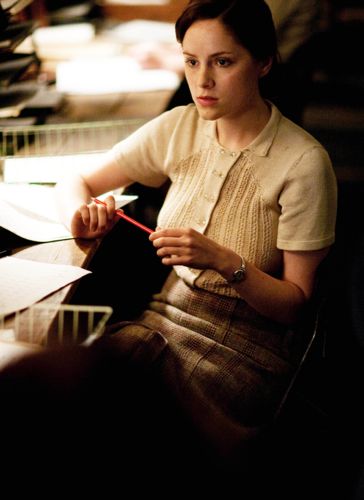
Bel's costumes run to a strict work uniform of form-fitting pencil skirt suits and brightly coloured jersey dresses. She actually has a couple of near-identical outfits in block colours, indicating that she knows what suits to her and sticks to it. A practical consideration, when you remember that she works in the relatively conservative environment of the BBC in 1956. Obviously Bel wants to look good but there are no hints of frivolity in her appearance, for all that she's usually colourful and eye-catching. Outside work we only really see her wearing vampy cocktail dresses, which she suits amazingly well because Romola Garai has such a great hourglass figure. Unlike a lot of the other female characters she doesn't often wear makeup, and there are several scenes where we see her changing outfits very quickly -- the benefits of an efficient capsule wardrobe, as it would nowadays be called. Bel enjoys the effects of looking attractive and stylish, but doesn't really "dress up" in the same way girlier characters like Marnie Madden do. In fact she has what could be interpreted as a traditionally masculine attitude towards dressing, since she basically constructed her own equivalent of the formulaic suits her male colleagues wear every day.
When it comes to costuming, Freddie and Bel are a real odd-couple pair. In season 1 Freddie's slightly scruffy appearance is all part of his role as a maverick at the BBC, and indicates his refusal to buy into the kind of conventionality Hector Madden effortlessly represents. Ben Whishaw's skinny frame lends itself well to gawkiness and youth, but Freddie is far from nervous. In fact he's kind of a bantamweight fighter, doggedly following dangerous stories well after any other journalist would have compromised or given up. Also, in the first season a lot more emphasis is put upon Freddie's attitude towards social class, both because he's far more sensitive to class differences at this point and because the main storyline is so closely tied up in the lifestyle of the British aristocracy.
Freddie comes from a working-class background but is heavily influenced by his time as an evacuee with the aristocratic Elms family, and by his friendship with the upwardly-mobile Cambridge graduate Bel. He wears a shirt and tie because that's the only real option for a man who works in an office in the 1950s, but aside from that he quite openly doesn't care about fashion or style. Next to the handsome and well-tailored Hector Madden he looks unapologetically weedy and unkempt, something I suspect Freddie is oddly proud of. Wearing ill-fitting trousers and sweater-vests, he knows to his bones that he's different from all the rich and powerful people he writes about at work. There's one particular scene I remember from when Bel and Freddie spent a weekend at the country house of Hector's extremely upper-class wife, Marnie. They're given a full schedule grouse-shooting and dinner parties, for which Freddie is unashamedly unprepared. In the end Hector makes him borrow a full black-tie outfit, which of course swamps Freddie and makes him look like a Dickensian waif. This is a familiar trope in British costume dramas, most recently seen in Downton Abbey when a former chauffeur is scorned for showing up to dinner wearing an ordinary suit.
Freddie changes a lot between seasons 1 and 2, maturing past the kind of reverse snobbery he espoused when he first met Hector. At first, Freddie's constant state of mild dishevelment highlighted the differences between himself and Hector's classically handsome, well-to-do appearance. Interestingly, Hector probably put less thought into his appearance than Freddie did into his purposeful lack of style, since Hector not only has a wife who picks out his clothes for him, but he also has a backstage crew making sure he looks good enough for television. As for basic elements of personal grooming, Hector was in the army and probably went to boarding school, so his general neatness and devotion to masculine style conventions would have been drilled into him from a young age. At first Freddie rebels against all the things that a good suit and neat hair represent, but in season 2 he returns with greater confidence and different priorities -- and, for the first time, is in front of the cameras on a regular basis. The shabby cardigans are replaced with closely-tailored suits that actually fit his slim frame, and he mostly restrains himself to a rather subdued palette.
Continued in the Menswear of The Hour.
Read More
Posted in 1950s, bbc, costumes, it's historical, movie costumes i have loved, the hour, tv | No comments

Wednesday, September 26, 2012

The Bletchley Circle, Part 2: Costume Design.

Posted on 3:39 PM by christofer D
Previously: The Bletchley Circle.

Historical dramas have a symbiotic relationship with costume design, with the clothes in high-profile shows like Downton Abbey receiving almost as much coverage as the stars. I suspect that this is one of the contributing factors to the popularity of historical movies about aristocrats, since it's a lot easier to interview Keira Knightley about corset logistics for the fiftieth time than it is to publicise a bunch of photoshoots of people wearing muddy pinafores and staid woollen caps. I love a good crinoline as much as the next girl, but sometimes movies about The Poors can be just as visually interesting because the costumes can illustrate more than just a statement of expense and luxury.
Downton Abbey is the reigning queen of costume-design coverage because it just entered the 1920s, and fashion magazines looooove the 1920s. Downton is in an enviable position, costume-wise, because several of its main characters are real clothes-horses and are rich enough that it's believable for them to be agonisingly on-trend as the show inches forwards into the first years of "modern" fashion. Once you reach the mid-20th century, popular fashions begin to move fast enough that most viewers will know the time period without much need for scene-setting, whereas it would take a historian to tell the difference between, say, 1830 and 1850 based on visuals alone. The problem is that it's easy to get carried away with year-by-year trend accuracy, and forget that not everyone could or even want to be up-to-date with the very latest styles.

Lucy
The popular image of 1950s fashion stems from Dior's New Look, a "return to femininity" after the supposed horror of having to wear trousers, uniforms and sensible shoes during wartime. (Unsurprisingly, the New Look was not immediately met with widespread jubilation -- I imagine that a couple of our Bletchley girls would have been less than enthused about the return of the corset girdle.) Full-skirted New Look outfits have never really gone out of style for things like prom dresses and semi-formalwear because they still represent a certain kind of 1950s ultra-femininity. But while The Bletchley Circle is set in 1952, it's very aware of the social background of its main characters, none of whom are exactly fashion plates. In some ways it reminded me of Tinker Tailor Soldier Spy, a movie whose story relied upon a particular historical setting but whose visuals were often strangely nebulous when it came to time-specific details. A couple of the younger characters in Tinker, Tailor were very obviously living in the 1970s, but many of the older men were either stuck in the past, or were just wearing the same suits they'd been wearing for the past twenty years. Which is, I think, satisfyingly realistic.
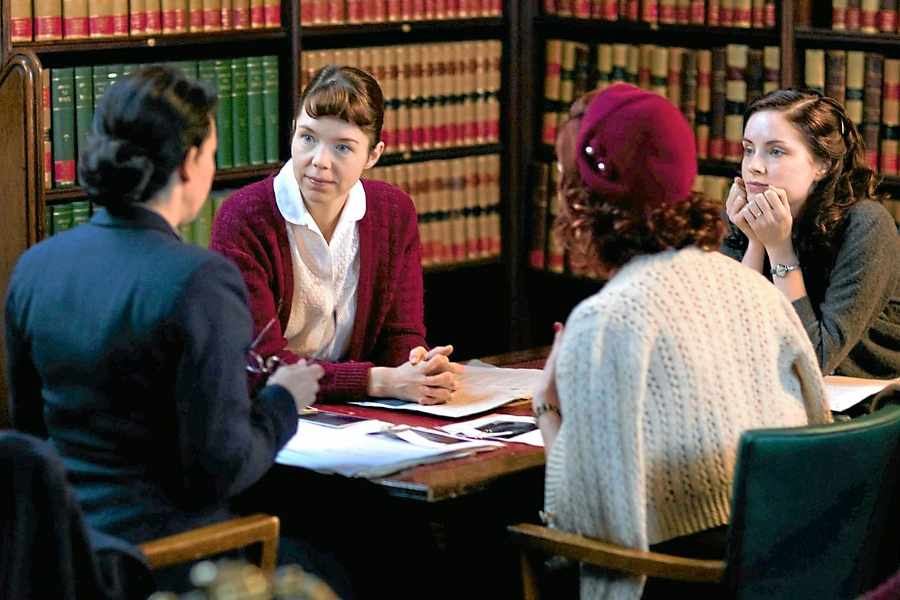
From left to right: Susan, Millie, Lucy, and Jean.
People don't just throw away all their old clothes as soon as a new decade rolls in. In The Bletchley Circle, Jean's matronly suits could easily have been worn by her character any time from 1935 to the present day, and Susan isn't much more fashion-forward. In fact, Susan is gloriously lacking in vanity, dressing in a selection of sensible, drab skirts and home-made knitwear. I kind of love the fact that she wears no makeup whatsoever, which is vanishingly rare to see on TV. It definitely adds to the contrast between Susan and Millie -- Millie being the character who spends the most time and money on her appearance despite probably being the poorest person in the group.
While Jean, Susan and Lucy are still mostly stuck with rationing-era clothes, Millie is closer in appearance to a classic 1950s look. She wears trousers and headscarves, and understands why a young woman would follow a strange man off a train in order to buy black-market cosmetics. When it comes to the moment when Lucy has to play decoy to lure in the Strangler, Millie is the one who supplies the dress and the lipstick. That scene was a real standout for me because the characters evidently had such a clear idea of what kind of look they were going for, whereas the end result seemed, to a modern eye, to be relatively sedate. It was a very narrow, precise cultural distinction, hinted at in the first episode when Susan's husband makes an offhand remark about the Strangler's victims being "not our kind of girls". That kind of girl being young single women who take the evening train home from work by themselves, and wear makeup. Yet if Lucy's temporary disguise as that type of girl had been introduced at the beginning of the show rather than halfway through (as a contrast to her frumpier outfits as a working-class housewife), I doubt that any viewer would have picked it out as being in any way unusual.
Lucy, after her makeover.
One last thing: UNDERWEAR. You do see Lucy getting undressed at one point, but I was pleased to find out that the costume designer made them all wear 1950s underwear under their clothes. This may sound like a weird thing to appreciate, but underwear does make a big difference to whatever is worn on top, particularly once you get beyond the long reign of the corset. Not only have ideal body-shapes changed a lot over the past few decades (thanks, idiotic internet memes, we know that Marilyn Monroe was "fatter" than "modern supermodels"), but "normal" body-shapes have changed as well. A middle-aged woman in 1952 would have been a young adult during the Great Depression and lived with rationing for over a decade of her life, which was definitely a contributing factor towards dress and waist sizes being dramatically smaller then than they are today. Add to that the fact that people were aiming for different body-shapes than we do, and it's surprisingly difficult for modern-day actresses to successfully wear fashions from 50+ years ago. Particularly if, as in this show, the costumes were at least partially made up of real vintage clothing. Some uncomfortable stockings and a pointy bullet-bra not only mean that the clothes look and fit better, but they help the actors stand and walk correctly as well.
Millie
Read More
Posted in 1940s, 1950s, costumes, it's historical, tv | No comments

Monday, September 24, 2012

The Bletchley Circle

Posted on 12:44 PM by christofer D
This may seem like an idiotic complaint coming from someone so obsessed with costuming and appearances, but one of the reasons why I'm so judgemental about historical dramas is that they're often so much more concerned with style than with substance. Not that style's necessarily a bad thing, since if historical dramas were actually "accurate" then it'd be damn near impossible to write them for a modern audience. A tremendous amount of research and effort goes into making things like Downton Abbey and Titanic into glittering caricatures of a particular time-period, but it's less common to see that same effort go into the non-visual aspects of the setting, mostly because very few people want to watch a movie that directly reflects the culture of actual real-life humans in the 17th century. You know, back when everyone was stunningly racist, people had wooden teeth, and public executions were the popular equivalent of Keeping Up With The Kardashians.
The Bletchley Circle is one of those rare historical dramas that combines modern writing styles (in this case, a murder mystery) with real emotional and psychological fidelity to the time-period. British television is unwaveringly obsessed with the two World Wars (as evidenced by the simultaneous popularity of Downton Abbey, Upstairs/Downstairs and War Horse, not to mention Doctor Who's unerring ability to end up in 1940s England at least once per season), but I can't remember having seen anything that illustrates the post-war period as well as this show does. The protagonists are four women who worked as codebreakers at Bletchley Park during WWII, but following the War found themselves falling into dull and disappointing routines either as housewives or in jobs that failed to measure up to the excitement of foiling Nazi spies. When we first meet these women they're in their element, working diligently to break German codes and help the men stationed overseas, but the moment the show skips forwards to 1952 it's immediately obvious that things have changed for the worse.

Susan Gray, your new role-model.
It's common knowledge that after the War many women failed to regain the kind of power and freedom they'd been allowed during wartime, but The Bletchley Circle goes beyond that. In almost every scene, there's this palpable awareness that this is a story about an entire generation of people who have been emotionally obliterated by the War. On top of the main characters' frustration with being reduced to "women's work", it's glaringly obvious that no one talks about anything of importance -- that not only are these women legally forbidden to discuss their wartime work due to the Official Secrets Act, but no one wants to talk about anything that disturbs the banal veneer of peacetime Britain. It's incredibly 1950s. I could go on for hours about how brilliant this show is when it comes to the grim, low-level, everyday details of emotional trauma while still managing to be an uplifting story about friendship and a straightforward crime procedural.
At its heart, this was a "getting the gang together" story like Ocean's 11 or The Avengers, with the atypical detail that all the conflict was external rather than coming from clashes between the main characters. There's no macho posturing or shouty arguments with unwilling police chiefs here -- more like a quiet acceptance from the get-go that very few people are going to take them seriously, so they may as well just get down to business. With no practical knowledge of how to track down a serial-killer, the four women reverse-engineer their deductive methods from the way they used to track Nazi troop movements and spies during the War. It's the ultimate Make Do And Mend -- working out new ways to do old jobs, and finding out that they're actually better at it than the experienced professionals who ignore them.
The main focus was on Susan, a housewife whose ongoing fascination with solving the Strangler mystery is impossible to explain to her husband, a war veteren whose main desire is to live as safe and conventional life as possible. Susan has a head for mathematics and is fuelled by a secret streak of indomitable self-confidence, but unlike most maverick TV detectives is is far from a loner wolf. She's the one who brings the rest of the gang together, exhibiting a perversely enthusiastic attitude towards the "puzzle" until she encounters the horrifying reality of the crime for the first time. The rest of the Circle is made up of Jean, a matronly who used to be their supervisor at Bletchley; Lucy, a timid newlywed with a photographic memory; and Millie, a down-on-her-luck "free spirit" (by 1950s standards, at least) who went traveling after the War but had her adventures cut short by lack of funds. While some shows would have emphasised the differences between these women, The Bletchley Circle focuses what brings them together: boredom, loneliness, and a sense of frustrated determination that only needs a spark to explode into its Wartime mood of bustling efficiency.
My only criticism is that although The Bletchley Circle is thoroughly female-oriented in way one rarely sees in mainstream crime TV, it includes some surprisingly cliched forays into torture-porn whenever another young woman is murdered. These kids of scenes have become so run-of-the-mill that I'd barely remark on them showing up BBC Sherlock or The Killing, but since The Bletchley Circle is otherwise so thoughtful and subtle in tone, I found they really stood out. To audiences already familiar with crime TV and serial-killer fiction, this show supplies nothing new in the way of murder and mayhem. In fact, the idea of a mysterious killer strangling young women on the streets of London seems almost prosaic when compared to your CSIs and your Hannibal Lecters. But not only are our detectives from an era before the influences of procedural crime dramas, they exist in a society that is still tentatively easing back into peacetime and is unwilling to acknowledge any kind of upset to normalcy. Even though these women are undoubtedly on the side of the angels, there's no question that they will keep their work a secret from everyone they know, even when it begins to endanger their lives.

Next: The costumes of The Bletchley Circle.

Read More
Posted in 1950s, it's historical, tv | No comments
Older Posts Home
Subscribe to: Posts (Atom)

Popular Posts

  • Master & Commander: The Far Side of the World. (Part 2)
    Previously: Master & Commander, Part 1. The characters in Master & Commander have a lot to say about the division between Navy and n...
  • Costuming & design in NBC's Hannibal: Hannibal Lecter's wristwatch.
    As part of my ongoing series on costume and design in Hannibal , I'm going to post my first guest blog with contributions from an outsi...
  • The costumes of X-Men: First Class, Part 2: Menswear.
    Part 1: Womenswear. OK, let's be real here. 99% of this section is gonna be about Erik and Charles, firstly because 99% of the movie is...
  • Costuming and Design in Captain America: The Winter Soldier -- Steve & Bucky.
    Part 1: "Trust No One" -- How Captain America became the gritty superhero we never knew we wanted. Part 2: HYDRA, Sitwell, and div...
  • Teen Wolf 2x09: Party Guessed.
    Previously: Teen Wolf 101: An introduction to the eighth wonder of our world . (Now available in audio as well!) Why does Teen Wolf hate ha...
  • Capitol Couture in The Hunger Games.
    It's a little late for a review of the Hunger Games movie itself, so in summary: I thought it was an excellent adaptation, and the few t...
  • Teen Wolf: Tattoo.
    Previously: Teen Wolf 101: An introduction to the eighth wonder of our world . Welcome to Teen Wolf! The show where the shirts are off, and ...
  • The ultimate TEEN WOLF DRINKING GAME.
    OK, the midseason finale is upon us. After tonight, there's no more Teen Wolf until January 2014. To help you deal with the pain, I'...
  • Harry Potter, costume design, and wizarding fashion in 1920s New York. (Part 2)
    Previously: Part 1 . Most wizarding robes in the Harry Potter movies are a combination of bell-sleeved faux medieval robes, and old-fashion...
  • Costumes and design in NBC's Hannibal, Part 1.
    I probably should've been writing about the costumes of Hannibal from the very start, but I confess to feeling a little overwhelmed. The...

Categories

  • "it's historical"
  • 1920s
  • 1940s
  • 1950s
  • 2014
  • accessories
  • agent carter
  • agents of shield
  • alexander mcqueen
  • alexander wang
  • alien
  • alien quadrilogy
  • aliens
  • apocalypse fashion
  • armour
  • avengers
  • bad movies
  • bad reviews
  • batman
  • bbc
  • benedict cumberbatch
  • big bang press
  • books
  • captain america
  • chanel
  • china
  • chris kane
  • comics
  • constantine
  • conventions
  • cosplay
  • costume design
  • costumes
  • couture
  • dance
  • dc
  • dior
  • dior homme
  • doctor who
  • dolce and gabbana
  • duckie brown
  • duro olowu
  • dystopias
  • elementary
  • erdem
  • fall 2012
  • fall 2013
  • fanart
  • fandom
  • fanfiction
  • fashion
  • fashion week
  • fausto puglisi
  • figure skating
  • game of thrones
  • gareth pugh
  • givenchy
  • goth
  • gwyneth paltrow
  • haider ackermann
  • hannibal
  • harry potter
  • hugo awards
  • hunger games
  • interstellar
  • interviews
  • IRL
  • iron man 3
  • it's historical
  • james bond
  • jason wu
  • jean paul gaultier
  • jonathan saunders
  • jw anderson
  • karl lagerfeld
  • ladies in suits
  • links post
  • london
  • london fashion week
  • louis vuitton
  • marc jacobs
  • marketing
  • marvel
  • mary katrantzou
  • masterpost
  • mcu
  • mediocre
  • menswear
  • menswear fashion week
  • milan
  • movie costumes i have loved
  • movie costumes i have loved
  • movie reviews
  • movies
  • mugler
  • needs more gold
  • neil marshall
  • new york
  • nyfw
  • oscars
  • other writing
  • ozwald boateng
  • pacific rim
  • paris fashion week
  • peggy carter
  • penny dreadful
  • persional taste
  • person of interest
  • personal taste
  • peter pilotto
  • podcasts
  • prabal gurung
  • pre-fall 2012
  • pre-fall 2013
  • pre-spring
  • prometheus
  • punk
  • ralph lauren
  • rants
  • resort 2013
  • retrofuturism
  • revenge
  • rick owens
  • s/s
  • scandinavia
  • sci fi
  • sci-fi
  • scotland
  • set design
  • shakespeare
  • sherlock
  • sherlock holmes
  • SHIELD
  • shoes
  • snowpiercer
  • spring 2012
  • spring 2013
  • spring 2014
  • star trek
  • star trek into darkness
  • star wars
  • starfleet
  • stargate
  • stoker
  • street style
  • suits
  • superheroes
  • superman
  • supernatural
  • tailoring
  • teen wolf
  • the hour
  • the row
  • theatre
  • theyskens theory
  • thom browne
  • thor
  • thor 2
  • threeasfour
  • tom ford
  • tom hiddleston
  • tv
  • ulyana sergeenko
  • uniforms
  • upholstery
  • versace
  • victoria beckham
  • video post
  • viktor and rolf
  • vivienne westwood
  • walter van beirendonck
  • watches
  • writing
  • x-men
  • yohji yamamoto
  • zac posen

Blog Archive

  • ▼  2015 (4)
    • ▼  January (4)
      • Hugo Award eligibility & 2014 masterlist
      • Interview: Agent Carter costume designer Gigi Melton
      • Behind the seams of the Oscars' costume design cat...
      • A guide to 1940s costume design in Marvel's Agent ...
  • ►  2014 (38)
    • ►  December (3)
    • ►  November (3)
    • ►  October (3)
    • ►  September (1)
    • ►  August (1)
    • ►  July (3)
    • ►  May (1)
    • ►  April (8)
    • ►  March (4)
    • ►  February (2)
    • ►  January (9)
  • ►  2013 (68)
    • ►  December (2)
    • ►  November (2)
    • ►  October (7)
    • ►  September (9)
    • ►  August (5)
    • ►  July (9)
    • ►  June (6)
    • ►  May (4)
    • ►  April (3)
    • ►  March (5)
    • ►  February (11)
    • ►  January (5)
  • ►  2012 (122)
    • ►  December (6)
    • ►  November (11)
    • ►  October (11)
    • ►  September (13)
    • ►  August (9)
    • ►  July (12)
    • ►  June (13)
    • ►  May (8)
    • ►  April (6)
    • ►  March (7)
    • ►  February (13)
    • ►  January (13)
  • ►  2011 (32)
    • ►  December (8)
    • ►  November (10)
    • ►  October (13)
    • ►  September (1)
Powered by Blogger.

About Me

christofer D
View my complete profile