Why you need to watch Spanish Snow White movie ...

  • Subscribe to our RSS feed.
  • Twitter
  • StumbleUpon
  • Reddit
  • Facebook
  • Digg
Showing posts with label sci fi. Show all posts

Sunday, November 9, 2014

Interstellar, costume design, and the difficulties of "realistic" visual worldbuilding.

Posted on 10:38 AM by christofer D

Interstellar is one of those movies where the costume design is almost invisible, which is part of what makes it so interesting. The simplest explanation is that the visual style is purposefully "realistic" and avoids any kind of futurism... which in itself is unrealistic. A conundrum, right? Technically, it doesn't make sense for people 50-100 years in the future to wear the same clothes as people in 2014. But from the perspective of a filmmaker who wants his apocalyptic sci-fi film to be taken seriously, this aesthetic decision makes perfect sense.


The earthbound setting of Interstellar is a classic American fantasy: a manly farmer hero, raising his kids in a bleak, rural landscape. Despite the film's image as a deep and thoughtful space epic, it still relies on the familiar old Hollywood scenario of a messianic white American dude being the one person who can save mankind. (And yes, I know his daughter does the actual saving, but this is very much a film about Cooper, not Murphy.) Underdog heroes NASA and Matthew McConaughey save humanity while the rest of the world is apparently helpless. Politically and socially, this is a tired old trope, but it aligns well with the kind of generic hero that can be inserted into a complex movie with minimal exposition. Cooper is the kind of guy who, for better or worse, is perceived as "universal." Luckily, McConaughey's performance was brilliant.

So here we have Coop and his kids, looking both relatable and realistic in their jeans and hoodies. This is the difference between a meticulously researched film that is actually realistic, and a film whose worldbuilding gives the appearance of realism, and therefore does not jolt viewers out of their comfort zone. On the whole, the appearance of realism tends to be the better choice. We're watching fiction, after all.


Decades in the future, the characters on Earth continue to wear clothes that look nondescript in the context of present-day fashions. We see Murph in her practical, neutral-toned outfits both at work and when visiting her brother at the farm. Judging by the clothes worn by Murph and her peers, fashion has stopped evolving altogether. 

As someone who follows fashion, I'm certain this level of sartorial stagnation could never happen in real life. Even within a dying civilization where fewer new clothes are commercially available, fashions would continue to change over time. But I understand why Christopher Nolan and his costume designer made this decision, because it grounds the film in a sense of reality -- or rather, what we think of as reality in 2014. The other option would be to dress Jessica Chastain in futuristic outfits to illustrate the passage of time, which would clash with Nolan's desire to distance himself from the popular visual tropes of the Hollywood sci-fi genre.

When we see Murph wearing nondescript shirts and jackets, we only think of the passage of time in relation to to her age and Cooper's journey, not in the general sense of what year it is for the rest of the world. We already know the film is set in the future, so there's no point in introducing the costume equivalent of a flying car.


The space suits are the only costumes that look like "costumes" in this film, so they're the only ones that really get discussed in promotional interviews. The earthbound costumes are designed to be absorbed passively without any kind of conscious thought, rather than reminding the audience that they're watching a work of fiction.

In this interview, Interstellar costume designer Mary Zophres says, “My first, gut instinct was that you should not anticipate what the future is going to look like. In fact, there is no attention paid to sartorial aspects at all. It’s unimportant.” She goes on to say that the space suits were meant to look like they'd been cobbled together from spare parts. Since most viewers' personal image of a space suit is still based on the astronauts of the late 20th century, that's what they went for in Interstellar. Any additions or changes were for purely practical purposes.


Costuming is always important to the way we consume a movie, but it's particularly important to Christopher Nolan's work as a writer and director of science fiction blockbusters. All of his best-known films are out-and-out fantasy (The Dark Knight, Inception, The Prestige), but their costumes and set design are intended to add a veneer of realism. 

Nolan movies are treated with an unusual amount of respect compared to other sci-fi and fantasy blockbusters, and I'm pretty sure his costume design choices are a major contributing factor to this attitude. With the unavoidable exception of Batman, all of his characters are dressed to look as normal and everyday as humanly possible, which distracts us from the fantastical concepts behind each movie. In Inception (perhaps my favourite costume design film of all time) Nolan is telling a story of pure fantasy, but it's illustrated in the visual language of a real-world drama.


Dreams are depicted as buildings and hotel rooms full of everyday humans, and the only fantasy elements are the stretching dimensions and timescales of the dream world. Even those are introduced to us by an architect who carefully explains the situation by scribbling a diagram on a piece of paper -- which, incidentally, is also how Nolan explains wormhole travel in Interstellar.

Because most of Inception takes place in this realistic urban landscape, and because all of the characters are dressed in staid, businesslike clothes, it feels more like a corporate espionage thriller than a successor to the worlds depicted in movies like Dark City, Paprika and The Matrix.


In the case of Interstellar, we're watching a movie that melds sci-fi ideas about relativity, apocalyptic climate change (more or less), and space travel. But we're also watching a Hollywood fairytale where NASA selects an American everyman farmer dude to lead a world-saving space mission, where five-dimensional beings help him transmit Morse Code messages to his daughter through time and space. Humanity is saved by a combination of the power of love and faith, and a message sent via books falling off a shelf and the ticking of a wristwatch. 

As a viewer, this combination of hard sci-fi and nonsensical Hollywood fantasy requires a herculean feat of suspending one's disbelief. We need all the serious and "realistic" trappings we can get. Hence why Interstellar was marketed with Google-sponsored lesson plans and interviews with the film's astrophysicist, and why Nolan spent so much time on the ground-level worldbuilding elements of Coop's farm, the NASA labs, and the overall aesthetic of Earth scenes taking place in a contemporary setting.


I usually tend to write about costume design from a characterization standpoint, but characterization is rarely an important aspect of a Nolan film. In Interstellar, the most personal costuming detail is Cooper's jacket -- which is later copied by Murphy as an adult, as she wears a jacket that looks very nearly identical to her father's. In amongst a cast of characters with no individual style whatsoever, this is a beautiful little personal touch; a subtle sign that Murph hasn't abandoned her father's memory quite as thoroughly as she likes to think. 


Further reading
  • "Why won't Christopher Nolan just embrace sci-fi?"
  • My response to people who object to Interstellar being described as a Hollywood fantasy.
  • The costumes of Alien: Uniforms and characterization. 
  • Space suits, retrofuturism, and Prometheus.
  • Supercut of Christopher Nolan's favourite movie tropes.
  • Q&A with Jeffrey Kurland, costume designer of Inception.
  • Article discussing Interstellar's space suits.

Tweet
Read More
Posted in costume design, interstellar, movies, sci fi | No comments

Tuesday, September 10, 2013

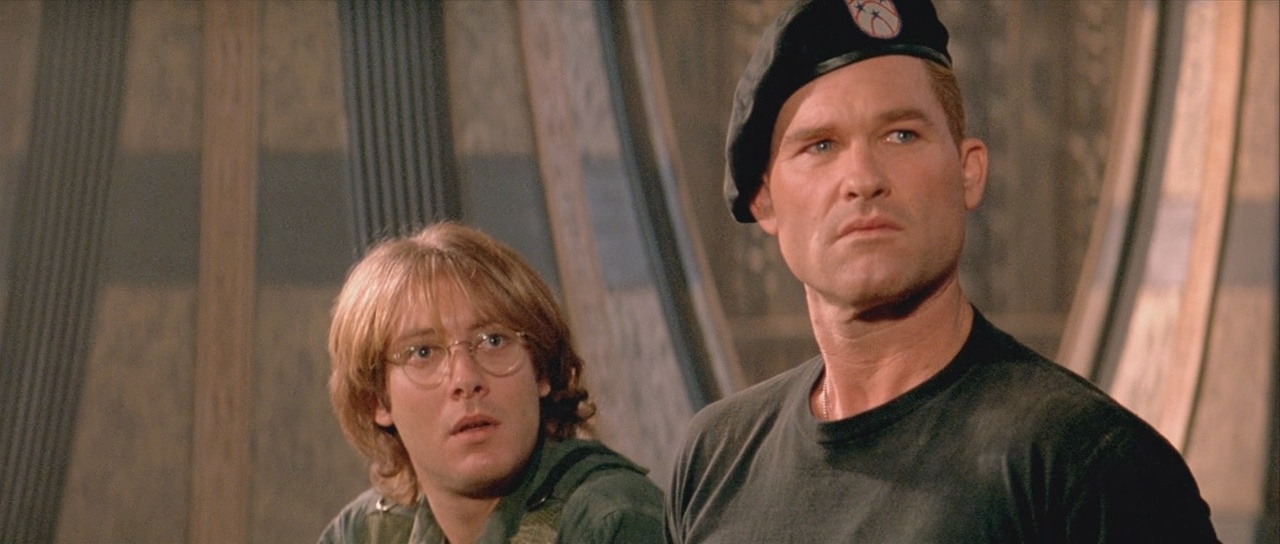
Stargate: Watch it. Love it. Learn educational info about real "Egyptian" "archaeology".

Posted on 2:26 PM by christofer D
Rewatching Stargate for the first time since I was 14, I suspected that it would turn out to be terrible. Partly because my 14-year-old self was not the most sophisticated of movie critics, and partly because I've gained a degree in Ancient History & Archaeology since then. That kind of thing tends to put a dampener on appreciating any media that attempts to be "historical" about "Egypt". Happily, Stargate is so far away from both history and Egypt that it's basically fanfiction for everyone's favourite aliens-built-the-pyramids conspiracy theory, Chariots of the Gods. It's kinda like how most paleontologists love Jurassic Park because FUCK YEAH DINOSAURS, even though the entire movie is like, "OK, we've decided to make Velociraptors 15 times their natural size, For Reasons."
The most surprising (and vaguely depressing) thing about Stargate is how well it holds up when compared to most family-friendly action blockbusters from the past ten years or so. Obviously cinema history is written by the victors and the good movies are generally the only ones to survive, but I still feel like Stargate represents a kind of 80s/90s blockbuster high point that no longer exists. Looking at things like Jurassic Park, The Goonies, The Mummy, Die Hard, etc, probably the only recent adventure movie that measures up is Pirates of the Caribbean. I realise this is cutting a ruthless swathe through a decade of Hollywood, and I'm not saying there haven't been any excellent blockbusters in that time. But compared to something like Stargate or Jurassic Park, recent box-office successes like Avatar or The Dark Knight Rises seem almost tragicomically bland and formulaic.

Many believe that the reason why recent mainstream movies seem so similar is because the filmmakers are all just following a detailed, 15-step plot structure. Which, in itself, is not necessarily a bad thing. Some storylines work just because the pacing is perfect, the structure fits in with our idea of how a narrative should ~feel, and it's satisfying to watch the Good Guys pound the Bad Guys to the pulp in an Inevitable Final Showdown. Stargate doesn't follow this exact structure, but it's still essentially a story about a nerd and a jock teaming up to save the world by nuking an alien spaceship. It just executes this plotline in a far more interesting and engaging way than most movies of the genre, partly because the pacing is brilliant and partly because the characters are three-dimensional and human.
Despite the fact that Stargate is about a group of American soldiers landing on an alien planet and helping the locals (all of whom are unambiguously non-white) overthrow their evil alien dictator, it somehow manages to be about a zillion times less racist than Avatar. Similarly, I was surprised to find that I was way less offended by the lead female character in Stargate literally being offered as a gift to Daniel Jackson, than I was by the treatment of women in Star Trek Into Darkness. The difference between Stargate and many blockbuster movies that use similar problematic tropes is that it seems to be aware of what it's doing. Sure, it's basically a silly entertainment movie about superpowered Egyptian god aliens, but the worldbuilding is solid and when characters and situations are racist or sexist, it actually makes sense in context. Whereas in most adventure movies in modern/futuristic settings, there's really no explanation for why 90% of the characters onscreen are male, or why the few female characters are all super-hot and wearing a generically flattering outfit.
It doesn't take many brain cells to work out why the stupid trope of "US military guys save brown people and/or aliens from tyranny" exists, but in Stargate we at least get a reasonable explanations for how this situation came about. For example, Ra has stupendously impressive technology at his disposal, appears to be a god (meaning that it makes sense to be afraid of weird-looking outsiders coming out of the pyramid), and he forbade reading and writing. That last part being the most significant, because Sha'uri secretly teaching herself to read is ultimately what saves the world. Basically the main lesson of Stargate is that if women get a decent education, then everyone is way less likely to get blown to smithereens by evil alien overlords. (I'm only about 50% joking on that one.)
Stargate isn't exactly progressive, but it's lightyears ahead of most recent movies in the same genre. Daniel Jackson and Jack O'Neill are both in their 30s/40s and have adult problems: the death of a child; a failed academic career. Rather than being motivated by a self-centered adolescent journey of self-discovery or a fridged girlfriend, they have interesting reasons to be doing something as balls-out crazy as travel to an alien planet with no certainty of return. Daniel's thirst for knowledge -- just look at him when he first steps through the Stargate -- is the true beauty of geekdom, while Jack is literally on a suicide mission. Honestly, these are both infinitely more satisfying explanations than anything we get for why the characters in Prometheus (a supposedly classy and cerebral "adult" blockbuster) are traveling to their unknown intergalactic destination.
Physically, Kurt Russell (Jack O'Neill) is half the size of most modern action heroes, and Sha'uri wears double the clothes of most of the guys in the movie. The most sexualised (or at least the most beautified) character in the movie is Ra, who -- while somewhat falling in with the whole "effeminate men = scary aliens" thing -- makes sense in context because his sparkly, immaculate appearance fits with the Egyptian scenario of an opulently wealthy ruling class forcing everyone to work for them and worship them as gods. Plus the ancient Egyptian (or "Egyptian") setting allowed the filmmakers to add the purposefully unsettling detail of Ra being served by a bunch of scantily-clad teen boys, which to modern eyes is pretty creepy -- even though all they're doing is standing around or carrying his cape for him.

Stargate has aged so well because it doesn't treat its audience like idiots. Specifically, it trusts you to work out what's going on without the assistance of clumsy expository dialogue. This is something I picked up on almost immediately, when Catherine, the leader of the Stargate project, explains to Daniel in a single sentence why he needs to come with her: He's homeless, and his grant money just ran out. DELICIOUSLY SIMPLE. Unlike Hollywood's current favourite storyline of "We all know the hero has to go and Do A Thing, but he is Reluctant, so first we must Explain What's Going On In Unnecessary Detail and finally Learn A Lesson about Being A Man."
Similarly, the death of Jack's son is explained in a single (realistic) exchange between two soldiers -- after we've already been introduced to Jack via a separate scene, much like Daniel's intro. Compared to the number of movies where entire scenes are wasted explaining who the characters are and what they're feeling/doing/thinking, this was music to my ears. There are plenty of movies from established franchises that use more exposition than this, to the extent that while Stargate trusts us to just understand what's going on onscreen, Man of Steel and The Amazing Spider-Man felt the need to re-explain in agonizing detail How Is Superhero Formed before getting on with the meat of a relatively simple origin story.
I'll be interested to see if I get many comments from people saying things like, "Actually, this whole post is just nostalgia bias." I do realise that sweeping statments like "Hollywood movies are getting worse," are pretty much meaningless, particularly when there have been at least two massive blockbusters in the last couple of years (Pacific Rim and The Avengers spring to mind) that I genuinely loved. But I also feel like there's an element of emotion and childlike wonder in things like Stargate or Jurassic Park that you rarely sense in recent movies of this type. The current trend is for a selfish man-child to overcome some kind of obstacle and then bloodlessly (in order to retain a PG-13 rating) destroy a bunch of buildings and/or people while defeating Evil. In some cases this works out relatively well (Iron Man; Thor), while in others (Star Trek Into Darkness; Man of Steel; TDKR; Elysium) it's not so successful.

However, when you look at the reasons why the good guys are victorious at the end of Stargate, it isn't actually tied into some spurious connection between ~facing your inner demons~ and suddenly gaining the power to pummel the enemy into submission. In fact, the final showdown in Stargate is preposterously small-scale when compared to all recent sci-fi blockbusters, leaving the main CGI presence restricted to worldbuilding details like the Stargate and the retractable helmets worn by Ra's guards. It's sort of fascinating to see how much the popular concept of "everyman with a dark past" characters like Jack O'Neill has changed since the 90s. In the drive towards more "serious" levels of angst and darkness, or more supposedly "relatable" coming-of-age hero roles, we've ended up with a pantheon of superheroes (and antiheroes, and reluctant everyman heroes) who seem more like sociopaths, douchebags, or selfish idiots.

When I think about how many movies I've seen where the main character's wife is killed or kidnapped as an excuse for the hero to go on a killing spree, it seems ridiculous that an ostensibly silly movie like Stargate could contain such a comparatively interesting and complex character as Jack O'Neill. This guy is played by '90s Kurt Russell with a cartoonishly geometrical flat-top haircut, his main role is to look angry and punch aliens, and yet he's still a poignant commentary on American masculinity and mental illness in the military.

In the end, the good guys in Stargate win because a slave girl taught herself to read, a nerd was so nerdy he risked his life to go translate some hieroglyphs on an alien planet, and a suicidal Air Force jock decided to disobey orders and not let off a bomb. Daniel Jackson, a stereotypical academic with allergies and the good ol' Crackpot Movie Science Theory (TM), is actually the main character, with Jack taking a slightly secondary role. The people of the alien planet get to have their own revolution, with minimal bloodshed and without a bunch of US military dudes leading the charge. And the only reason why any of this happened is because the 80-year-old daughter of a 1920s Egyptologist became so obsessed with an old Egyptian artefact that she spent her whole life researching it until people finally got to travel to other planets. Which to me is a far more compelling origin story than any amount of daddy issues, dead wives, or misunderstood loner antiheroes. Well done, Stargate. Well done, Roland Emmerich. Well done, everyone who managed to read all the way to the end of this stupidly long post. And if you thought I'd be writing about costume design: sorry. Come back in a couple of days.
Read More
Posted in movies, sci fi, stargate | No comments

Wednesday, September 4, 2013

Dressing for the Apocalypse: How to build a believable dystopia.

Posted on 11:14 AM by christofer D
This is actually the sequel to a post I made in 2011, way back when this blog was still a baby. My love for dystopian/post-apocalyptic movies never grows old. And so today we're gonna look at some dystopian sci-fi movies that somehow have even less believable premises than "dragons erupt from the London Underground". (Seriously: Reign of Fire. Watch it. Dragons.)
I'm talking about the Uncanny Valley of filmmaking. This term usually refers to robots, in that the closer a robot gets to looking "human", the more unsettling it becomes. Roombas are cute because we can anthropomorphise them into being sweet little cartoon pets, while mannequin-like humandroids are totally creepy because they're not quite human enough. And the same thing goes for sci-fi worldbuilding, kind of. Unless your worldbuilding is 100% on point, going into too much detail is a recipe for disaster. It just gives audiences more time the audience has to think about how much you're failing to explain.

Take Star Wars. There's a reason why so many first-generation fans were pissed about the whole "midichlorians" thing: the prequels were attempting to rationalise something that, from a narrative standpoint, really didn't need rationalising. The explanations provided by The Phantom Menace and, to a much greater degree, Prometheus (WHY TRY TO EXPLAIN ALIEN?), are about as useful as making a Back To The Future prequel that tries to make scientific sense of the Delorean. Meanwhile, Children of Men and 28 Days Later (both ~serious~ dystopian sci-fi movies) both start in media res with minimal explanations for their technically impossible scenarios, but are nonetheless totally believable.
Many dystopian movies fall solidly into the Uncanny Valley because someone thought up a vaguely ~plausible idea for a futuristic dystopia, but then failed to think any further. Case in point: Gattaca. Set in a society where everyone's lives are governed by their genetic destiny, Gattaca is working from a sci-fi idea that has the potential to make some kind of sense. The basic premise is that the competent yet genetically unmodified Ethan Hawke can't get a decent job unless he slathers himself in Jude Law's pureblood DNA to avoid detection: so far, so good. (And slightly homoerotic, mostly because that's Jude Law's forte.) Unfortunately, the first half hour of the movie is one long, unnecessary expositiory flashback, giving you ample time to ponder things like why the hell an entire society of rich, successful superhumans would all decide to get the same haircut. While a short story can get away with creating a fictional society based on a thought experiment, you can't really do that in a feature film.
The costumes in Gattaca are great fashion, but they're not great worldbuilding. In the interests of propping up the whole genetic predestination bit, everyone dresses in identical, monochromatic Calvin Klein-esque businesswear. An easy visual cue to let audiences to know that conformity is key, but not something that seems terribly plausible in an apparently capitalist society with a thriving class system. Ditto for Equilibrium, although the costumes in that movie are a lot more stylised and a lot less interesting. Gattaca was designed by Colleen Atwood, who has like 57 Oscars and is basically The Best, whereas the costumes in Equilibrium look more like early-2000s teen boy fantasies of what Cool Guys dress like: ie, long black coats and lots of hair gel. Thanks, The Matrix. (N.B. I find it doubly entertaining that in Equilibrium, the supposed martial arts badasses are dressed in the most restrictive clothing ever, to the extent that they may not have been able to move their legs properly. How on earth did Christian Bale manage?)
The visuals of movies like Equilibrium and Gattaca (and Aeon Flux, and Ultraviolet...) are, to me, the costuming equivalent of all those thousands of hard sci-fi novels that concentrate on the science fiction but forget to give the characters human personalities. Even in a world where everyone is genetically engineered to perfection (Gattaca) or everyone is drugged with emotional inhibitors (Equilibrium), it's never really articulated why people look so similar. And if they were pressured to wear identical outfits every day, they wouldn't be dressed to the same degree of neatness, a trait that varies enormously from person to person. Not that this really makes much difference to the overall quality of the film: it's just something that bugs me, personally. The most frustrating case is probably The Hunger Games, where the supposedly outlandish clothes worn by the super-rich Capitol citizens are ultimately quite formulaic.
Like all great sci-fi, Gattaca causes us to ask questions. Questions like, Why does this have an 82% rating on Rotten Tomatoes, when every single line of dialogue is such a stinker? Why is noted non-actor Gore Vidal here, acting in a lead role? Why does everyone in this kind of sci-fi future movie always seem to live inside a giant stainless steel refrigerator? It's definitely one of those 1950s thought experiment short story movies, which does shine through in some of the weirdly mid-20th-century retrofuturism visuals. (ie, Jude Law wears a lot of waistcoats, presumably because it's written into all his movie contracts.) The writer/director went on to win an Oscar for The Truman Show so I assume he got better, but Gattaca's problems can probably be summed up in this picture of Jude Law looking forlorn in his wheelchair, loitering at the bottom of a DNA helix-shaped staircase, I see what you did there:
I'm not saying it's impossible to write a dystopia where everyone wears near-identical outfits. All you have to do is create a scenario that explicitly shows us why people are motivated to look so similar, either because they'd be socially ostracised for looking too different (which I think is what Gattaca was going for), or because they only have access to a limited type of clothing. The former is so similar to the real world that all you'd have to do is show what happens to people who don't fit in, while the latter means you can show all the ways people try to express themselves while constrained by a dress code. Just look at Alien, where everyone modifies their standard-issue uniform to the extent that they all look completely different.
Strange Days, 1995.
Urban cyberpunk dystopias are always gonna be my favourite for costume design, because they acknowledge the diversity of street fashion -- albeit usually as a slightly dated nod to Japanese micro-trends. Once cheap, mass-produced clothes are available then people are going to start experimenting with fashion, particularly when we're talking about the kind of clearly Westernised (usually USA-based) societies we see in most dystopia movies. So for me, a quick shortcut to working out whether an onscreen dystopia is plausible is: Does it look plausible? Because unless you're lining everyone up at gunpoint every morning to make sure their government-issue jumpsuit is buttoned correctly, everyone is not going to look the same.

Postscript: I just rewatched the trailer to Equilibrium, and immediately thought, "This movie looks awesome." Am now fruitlessly trying to remind myself that it isn't. If you find yourself falling under its spell, just watch the scene where Christian Bale rescues a puppy: that's probably the best bit. 

Previously: Dressing for the Apocalypse, Part 1. 

Read More
Posted in apocalypse fashion, costume design, movies, sci fi | No comments

Saturday, February 23, 2013

Threeasfour, Fall 2013: The 13th sign of the zodiac.

Posted on 10:10 AM by christofer D
Thirteen outfits long, this collection was based on the signs of the Zodiac. Technically Ophiucus, the so-called thirteenth Zodiac sign, is actually a Zodiac constellation and therefore not directly connected to the exacting and fact-based science that is astrology, but whatevs. The combination of mysticism and stargazing made for an intriguing mix, resulting in some excellent sci-fi priestess outfits: one for each sign.
pics from Style.com
Sadly I couldn't work out which was which. The first was Ophiucus, but where did it go from there? Perhaps there's someone out there with some more astrology expertise who can help me out. But I don't think the designs are very literal. There certainly wasn't any single outfit out there that reminded me specifically of a bull, a ram, or a pair of twins.


New Age themes aside, this was an interesting and well-developed collection. Threeasfour tend to be a little eccentric anyway, but they're consistent in their eccentricities. Lots of asymmetrical tailoring and patterns made up of repeated circles, as seen in previous seasons.

One of my favourite aspects of this collection was the headwear, which was straight out of Gallifrey. Laser-cut (presumably?) from leather and what may have been cardboard, these crowns looked like clockwork or 3D renderings of mathematical diagrams.


We can only theorise who will actually end up wearing these designs. They'd make excellent costumes for a high-budget 1970s sci-fi movie, but sadly not many people in the real world actually dress like this. However, Threeasfour have successfully managed the weirdness of their brand for several years now, so I can only assume (and hope) that there are some people out there who are enthusiastically willing to spend $$$ on grey woollen chaps and wraparound Zodiac robes.


Read More
Posted in fall 2013, fashion week, sci fi, threeasfour | No comments
Older Posts Home
Subscribe to: Posts (Atom)

Popular Posts

  • Master & Commander: The Far Side of the World. (Part 2)
    Previously: Master & Commander, Part 1. The characters in Master & Commander have a lot to say about the division between Navy and n...
  • Costuming & design in NBC's Hannibal: Hannibal Lecter's wristwatch.
    As part of my ongoing series on costume and design in Hannibal , I'm going to post my first guest blog with contributions from an outsi...
  • The costumes of X-Men: First Class, Part 2: Menswear.
    Part 1: Womenswear. OK, let's be real here. 99% of this section is gonna be about Erik and Charles, firstly because 99% of the movie is...
  • Costuming and Design in Captain America: The Winter Soldier -- Steve & Bucky.
    Part 1: "Trust No One" -- How Captain America became the gritty superhero we never knew we wanted. Part 2: HYDRA, Sitwell, and div...
  • Teen Wolf 2x09: Party Guessed.
    Previously: Teen Wolf 101: An introduction to the eighth wonder of our world . (Now available in audio as well!) Why does Teen Wolf hate ha...
  • Capitol Couture in The Hunger Games.
    It's a little late for a review of the Hunger Games movie itself, so in summary: I thought it was an excellent adaptation, and the few t...
  • The ultimate TEEN WOLF DRINKING GAME.
    OK, the midseason finale is upon us. After tonight, there's no more Teen Wolf until January 2014. To help you deal with the pain, I'...
  • Harry Potter, costume design, and wizarding fashion in 1920s New York. (Part 2)
    Previously: Part 1 . Most wizarding robes in the Harry Potter movies are a combination of bell-sleeved faux medieval robes, and old-fashion...
  • Teen Wolf: Tattoo.
    Previously: Teen Wolf 101: An introduction to the eighth wonder of our world . Welcome to Teen Wolf! The show where the shirts are off, and ...
  • The costumes of Alien. Part 1: Uniforms and characterisation.
    It took me until the ripe old age of 22 to see Alien, mostly because my mother warned me for years that it was the Most Terrifying Film Ever...

Categories

  • "it's historical"
  • 1920s
  • 1940s
  • 1950s
  • 2014
  • accessories
  • agent carter
  • agents of shield
  • alexander mcqueen
  • alexander wang
  • alien
  • alien quadrilogy
  • aliens
  • apocalypse fashion
  • armour
  • avengers
  • bad movies
  • bad reviews
  • batman
  • bbc
  • benedict cumberbatch
  • big bang press
  • books
  • captain america
  • chanel
  • china
  • chris kane
  • comics
  • constantine
  • conventions
  • cosplay
  • costume design
  • costumes
  • couture
  • dance
  • dc
  • dior
  • dior homme
  • doctor who
  • dolce and gabbana
  • duckie brown
  • duro olowu
  • dystopias
  • elementary
  • erdem
  • fall 2012
  • fall 2013
  • fanart
  • fandom
  • fanfiction
  • fashion
  • fashion week
  • fausto puglisi
  • figure skating
  • game of thrones
  • gareth pugh
  • givenchy
  • goth
  • gwyneth paltrow
  • haider ackermann
  • hannibal
  • harry potter
  • hugo awards
  • hunger games
  • interstellar
  • interviews
  • IRL
  • iron man 3
  • it's historical
  • james bond
  • jason wu
  • jean paul gaultier
  • jonathan saunders
  • jw anderson
  • karl lagerfeld
  • ladies in suits
  • links post
  • london
  • london fashion week
  • louis vuitton
  • marc jacobs
  • marketing
  • marvel
  • mary katrantzou
  • masterpost
  • mcu
  • mediocre
  • menswear
  • menswear fashion week
  • milan
  • movie costumes i have loved
  • movie costumes i have loved
  • movie reviews
  • movies
  • mugler
  • needs more gold
  • neil marshall
  • new york
  • nyfw
  • oscars
  • other writing
  • ozwald boateng
  • pacific rim
  • paris fashion week
  • peggy carter
  • penny dreadful
  • persional taste
  • person of interest
  • personal taste
  • peter pilotto
  • podcasts
  • prabal gurung
  • pre-fall 2012
  • pre-fall 2013
  • pre-spring
  • prometheus
  • punk
  • ralph lauren
  • rants
  • resort 2013
  • retrofuturism
  • revenge
  • rick owens
  • s/s
  • scandinavia
  • sci fi
  • sci-fi
  • scotland
  • set design
  • shakespeare
  • sherlock
  • sherlock holmes
  • SHIELD
  • shoes
  • snowpiercer
  • spring 2012
  • spring 2013
  • spring 2014
  • star trek
  • star trek into darkness
  • star wars
  • starfleet
  • stargate
  • stoker
  • street style
  • suits
  • superheroes
  • superman
  • supernatural
  • tailoring
  • teen wolf
  • the hour
  • the row
  • theatre
  • theyskens theory
  • thom browne
  • thor
  • thor 2
  • threeasfour
  • tom ford
  • tom hiddleston
  • tv
  • ulyana sergeenko
  • uniforms
  • upholstery
  • versace
  • victoria beckham
  • video post
  • viktor and rolf
  • vivienne westwood
  • walter van beirendonck
  • watches
  • writing
  • x-men
  • yohji yamamoto
  • zac posen

Blog Archive

  • ▼  2015 (4)
    • ▼  January (4)
      • Hugo Award eligibility & 2014 masterlist
      • Interview: Agent Carter costume designer Gigi Melton
      • Behind the seams of the Oscars' costume design cat...
      • A guide to 1940s costume design in Marvel's Agent ...
  • ►  2014 (38)
    • ►  December (3)
    • ►  November (3)
    • ►  October (3)
    • ►  September (1)
    • ►  August (1)
    • ►  July (3)
    • ►  May (1)
    • ►  April (8)
    • ►  March (4)
    • ►  February (2)
    • ►  January (9)
  • ►  2013 (68)
    • ►  December (2)
    • ►  November (2)
    • ►  October (7)
    • ►  September (9)
    • ►  August (5)
    • ►  July (9)
    • ►  June (6)
    • ►  May (4)
    • ►  April (3)
    • ►  March (5)
    • ►  February (11)
    • ►  January (5)
  • ►  2012 (122)
    • ►  December (6)
    • ►  November (11)
    • ►  October (11)
    • ►  September (13)
    • ►  August (9)
    • ►  July (12)
    • ►  June (13)
    • ►  May (8)
    • ►  April (6)
    • ►  March (7)
    • ►  February (13)
    • ►  January (13)
  • ►  2011 (32)
    • ►  December (8)
    • ►  November (10)
    • ►  October (13)
    • ►  September (1)
Powered by Blogger.

About Me

christofer D
View my complete profile